
Table of Contents
Thank you! Your submission has been received!
Oops! Something went wrong while submitting the form.

Published:
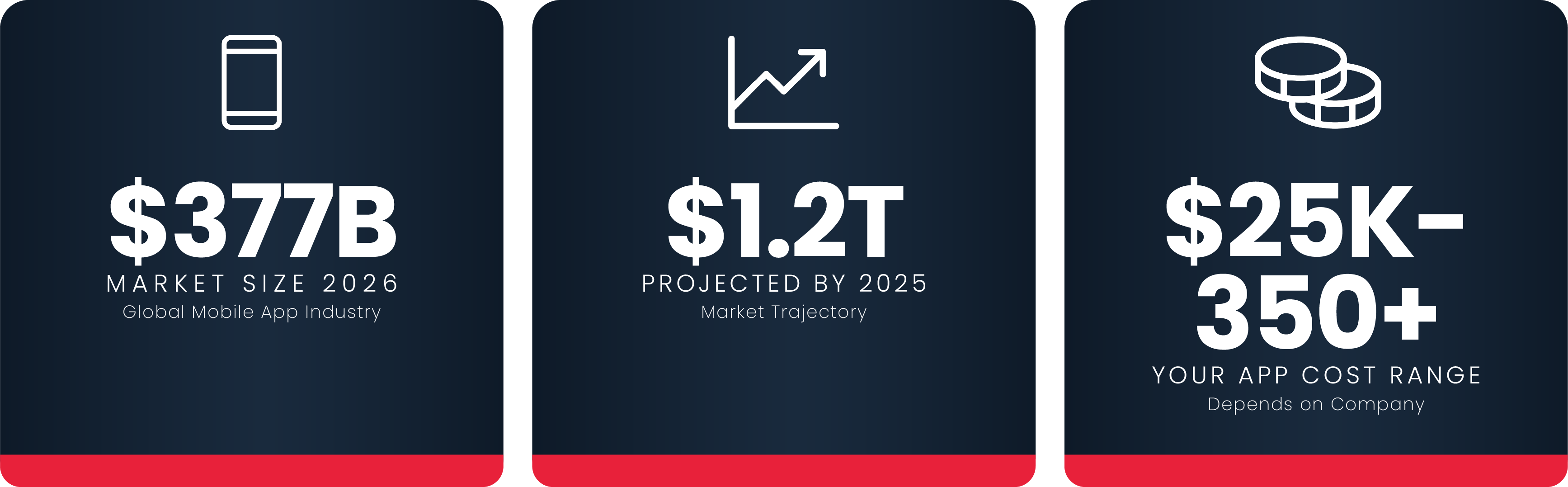
Building a mobile app in 2026 isn’t just about writing code. It’s about navigating rising developer rates, AI integrations, and shifting user expectations. Costs can range from $25,000 for a lean MVP development to well over $350,000+ for complex platforms.
So where does that money actually go? Let’s break it down in real terms, without the guesswork.
There’s no fixed price for mobile app development, and anyone giving you one quote is oversimplifying it. According to Business Research Insights, the global mobile app market is set to rise from $377.79 billion in 2026 on a trajectory to exceed $1.2 trillion by 2035.
The following table represents the cost to build a mobile app:
What’s different now is the baseline. Even a “simple” app is expected to be fast, secure, and polished. That alone adds time and cost.
If you look across the market, the average app project usually lands between $60,000 and $180,000, depending on scope, region, and tech stack.
Timelines follow the same pattern; more complexity means more time.
AI tools have sped up early development in 2026, especially for prototyping. But testing, backend architecture, and security still take time, so fully polished apps aren’t getting built overnight.
App cost isn’t just about coding; it’s the sum of decisions made across the entire lifecycle. According to Gartner, the IT market is expected to expand to 6.08 trillion in 2026 due to the high-level AI features now demanded in apps. So this is also increasing the price of mobile app development.
This phase sets the financial direction of the project.
Design decisions impact both budget and user retention.
This is where most resources are consumed.
Often underestimated, but critical.
Final steps still require time and precision.
Even after launch, updates and maintenance continue to shape the total cost over time.

Let’s discuss how we can help you craft a winning product strategy tailored to your goals.

Mobile app development costs shift depending on what the app actually does behind the scenes. Two apps might look similar on the surface, but the tech requirements underneath can be completely different, and that’s what drives the budget.
Estimated cost: $50k–$150k+
E-commerce apps usually start with simple products, a cart, and checkout, but don’t stay that way for long. Once you add real-time inventory, payment systems, and personalized recommendations, the workload grows fast.
Estimated cost: $80k–$300k+
Fintech apps are expensive because there’s no room for error. Secure transactions, identity verification, and regulatory requirements make even small features more complex to build.
Estimated cost: $70k–$300k+
Healthcare apps deal with sensitive data, which changes everything. Privacy rules, system integrations, and reliability requirements all add layers that slow things down and increase cost.
Estimated cost: $100k–$400k+
Social apps are heavy on infrastructure. Real-time feeds, messaging, and handling large user activity make them one of the most demanding (and expensive) types to build.
Most app budgets look clean on paper until the hidden costs start showing up. These aren’t edge cases; they’re part of running a real product, and ignoring them is where most budgets fall apart.
Launching isn’t the finish line. Bugs, OS updates, security patches, and new features all require ongoing work. Most apps need continuous updates just to stay functional and competitive. There is an estimated 15–24% of initial development cost spent annually on maintenance and updates.
Infrastructure quietly becomes a major expense as usage grows. Cloud servers handle traffic, CDNs improve speed across regions, and databases need to scale as user data increases. The more active your users, the higher these costs climb.
Building the app is one thing; getting users is another. ASO helps visibility, but most apps rely on paid ads or influencer campaigns to gain traction. Without a clear acquisition strategy, even well-built apps struggle to grow.
Publishing isn’t free. Apple and Google charge developer fees, and both platforms take a 15–30% cut on in-app purchases and subscriptions. That percentage directly impacts revenue, especially for subscription-based apps.
As the world's technology is growing at a fast pace, there is a need for advanced mobile apps that have features to meet the current industry standards. Mobile app development costs aren’t just about features; they’re about decisions. The tech stack you choose, how you scale, and how early you plan for growth all shape the final budget.

A poorly planned backend leads to scaling issues and expensive rewrites. Choosing the right architecture early reduces future infrastructure and maintenance costs.
Native offers better performance and control, while cross-platform reduces initial development time. The choice depends on complexity and performance requirements.
APIs speed up development but introduce dependencies, usage costs, and limitations that can impact scalability and long-term expenses.


