
Table of Contents
Thank you! Your submission has been received!
Oops! Something went wrong while submitting the form.

%20(1).png)
Published:
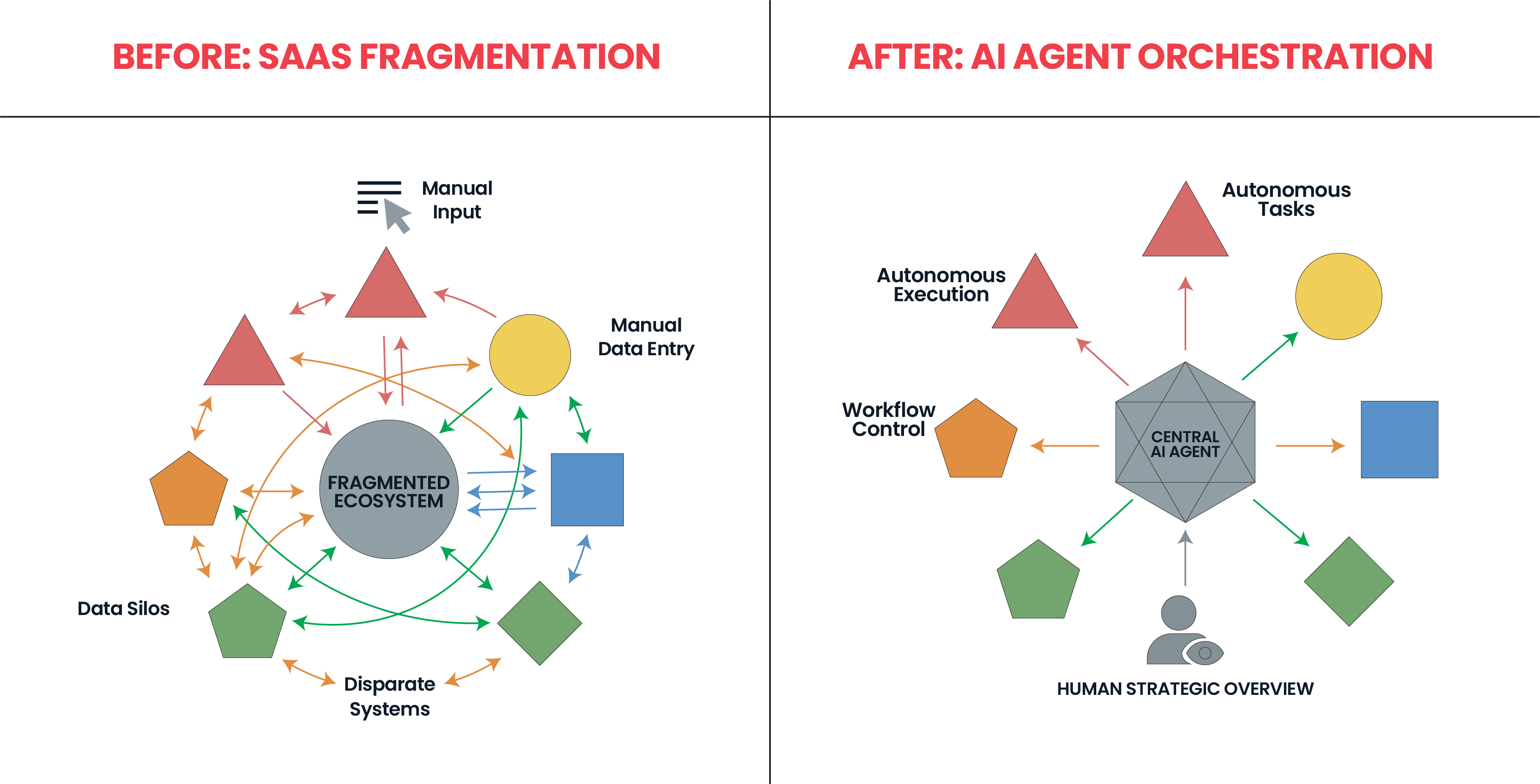
The traditional software-as-a-service (SaaS) model is hitting a wall because it still requires too much human management to be truly efficient. Although older software had some capabilities to streamline processes with automation, the real issue with conventional SaaS is that it induces “work about work.”
Instead of focusing on productive tasks, team members spend hours transferring data between apps or updating records to keep the system live.
AI agents change this dynamic by functioning as LLM-driven orchestration systems. Instead of only surfacing issues, AI agents can execute predefined workflows through connected systems to attempt resolution, typically within configured guardrails.
By 2026, the main goal of any substantial enterprise will be "execution," not just “automation.” In this article, you will learn the truth about how AI agents are replacing traditional SaaS workflows.
This evolution is not just about software getting faster; it's about changing the structural depth of how the work is done. AI agents become the connective element that not only understands the issue or task but also fixes it.
The following table shows the difference between AI agents and SaaS:

The key difference is that while the SaaS tools specialize in optimizing particular, siloed steps in a process, the AI agents optimize entire outcomes. This is the biggest turning point for any operation of a certain size. The competitive advantage has shifted from being about “workflow management” to being about “workflow intelligence.”
Organizations can reduce manual oversight in certain workflows by implementing AI agents with monitoring and escalation mechanisms. Allowing for the first time the redeployment of the most expensive resource, human beings, to higher-order strategic and creative problem-solving.

AI, automation & smart solutions are reshaping software. Let’s build future-proof technology for your business today!

This technology has moved beyond being a pilot program. It has become an essential part of the operating strategy. As Gartner states, in 2026, 40% of enterprise applications will contain AI agents that perform specific tasks.
Development cycles are being shortened with the insertion of AI agents into code review and CI/CD triggers. Project managers no longer need to tag tickets, as these agents perform backlog prioritization by assessing sprint velocity and technical debt in real time. This can reduce manual coordination within project management tools.
Hiring is made easier through autonomous systems that screen candidates and schedule interviews. These agents go beyond recruitment, as they can also assist in the onboarding process, track engagement, send performance reminders, and conduct compliance checks without a coordinator.
Support teams are shifting from basic chatbots to agents that can understand and resolve complicated issues and can predict issues as they come. These systems do not merely follow a script and can also analyze a customer's history and intent in order to triage tickets and implement resolutions, even across different systems, all at the same time.
There is a growing gap between access to AI and value creation. The tools are available, the challenge is the ability to integrate them into a sophisticated corporate ecosystem, requiring more than just a simple API connection.
According to McKinsey, 62% of organizations are already experimenting with AI agents, which proves that while the technology is ready, the real hurdle has shifted toward implementation.
The future of agents is promising, but for now, it collides painfully with the legacy systems of the past years.
Most core infrastructures were built decades ago and were not designed for real-time AI interaction. Adapting the systems and building efficient middleware is essential to integrate agents developed in today's times with databases from the past.
Fragmented systems limit what AI can see and determine, and poor data quality directly diminishes how reliable autonomous decisions are.
Stricter governance frameworks and evolving standards around compliance mean more complexity is needed during implementation to protect data.
Disruptions to workflows are a significant barrier, and with AI adoption being the ultimate measure of success, technology is of no use if the company resists AI agents.
Sustainable automation requires a shift away from superficial automation, as well as rigorous execution across these 3 elements:
Linking all AI efforts to concrete business outcomes, not just technical outcomes.
Building the framework for scalable and secure integration across multiple systems and platforms.
Automating pre-existing workflows and stimulating them to fully hold the advantage AI offers.
For organizations modernizing beyond traditional SaaS stacks, the advantage lies in working with technology partners who can integrate AI architecture and enterprise workflow design, not just implementation, but long-term operational alignment.


We can teach product teams and agile teams in continuous product discovery with the aid of the product discovery framework, which gives the product discovery process structure.
AI agents replacing traditional SaaS workflows is a myth, but AI, along with SaaS, can perform more operational functions better. True success requires abandoning pilot programs and focusing on intelligent integrated systems architecture for core workflows that deliver sustainable enterprise value.

Agents use iterative large language model inference and tool-calling loops to evaluate context and determine next actions. This allows them to attempt to fix issues themselves.
Not at all. Most AI agents in 2026 function as orchestration layers that interact with existing cloud-based systems via APIs.
The appropriate time frame to lead to an integration of agentic functions depends on the operational budget, but is expected to be around 2028.


