
Table of Contents
Thank you! Your submission has been received!
Oops! Something went wrong while submitting the form.

Published:
Trust in AI shapes how users interact with artificial intelligence in modern web development. It influences how people respond to user experience, AI interface design, and human-AI interaction.
The psychology of trust explains how users form expectations and interpret system behavior. Trust, psychology, and design are closely connected in AI systems. Psychology explains how users think and respond, while design shapes how that experience is presented.

Trust grows when artificial intelligence feels clear, predictable, and easy to use through user experience, interface design, and interaction design. Psychology plays a key role in how users interpret these signals and form trust.
Trust is shaped by both logic and feeling. From a psychology perspective, users rely on mental models to understand how AI systems behave.
Cornell University research on user trust in AI shows that trust depends on how systems behave and how users experience interaction.
Trust develops when systems behave consistently. Predictable outputs, stable performance, and clear feedback act as trust signals. From a design point of view, these signals help users understand what to expect. Psychology shows that repeated consistent behavior strengthens user trust over time.
Users trust systems when they understand them. Clear explanations, simple outputs, and visible system logic improve user experience. Design makes this possible by presenting information in a clear way. Psychology explains that understanding reduces uncertainty and supports stronger trust.
Control is a key part of trust. When users can guide interaction, adjust inputs, and explore outputs, they feel more confident. Design decisions that support control improve usability. From a psychological view, control increases comfort and strengthens trust in AI systems.
Predictability supports trust in AI by helping users understand behavior through consistent interaction, clear feedback, and a stable user experience in artificial intelligence systems.
Consistent behavior helps users build clear mental models. When systems respond in expected ways, users understand how they work. Psychology shows that predictability reduces uncertainty. Design ensures this consistency through structured interaction patterns.
Feedback helps users stay informed during interaction. Clear responses, visible updates, and simple outputs improve user experience. From a psychology perspective, feedback reinforces understanding. Design plays a key role in making feedback easy to notice and interpret.
Users trust systems when they know what will happen next. Design sets expectations through instructions, cues, and interaction flow. Psychology explains that clear expectations reduce confusion and support decision-making. This strengthens trust during human-AI interaction.
Confidence grows when users see reliable outputs. Stable behavior, clear responses, and consistent interaction design act as signals of trust. Psychology shows that these signals influence how users judge systems. Design makes these signals visible and understandable.
Users perceive artificial intelligence through user experience, interface design, and human-AI interaction. Psychology shapes how users interpret behavior, while design influences how that behavior is presented.
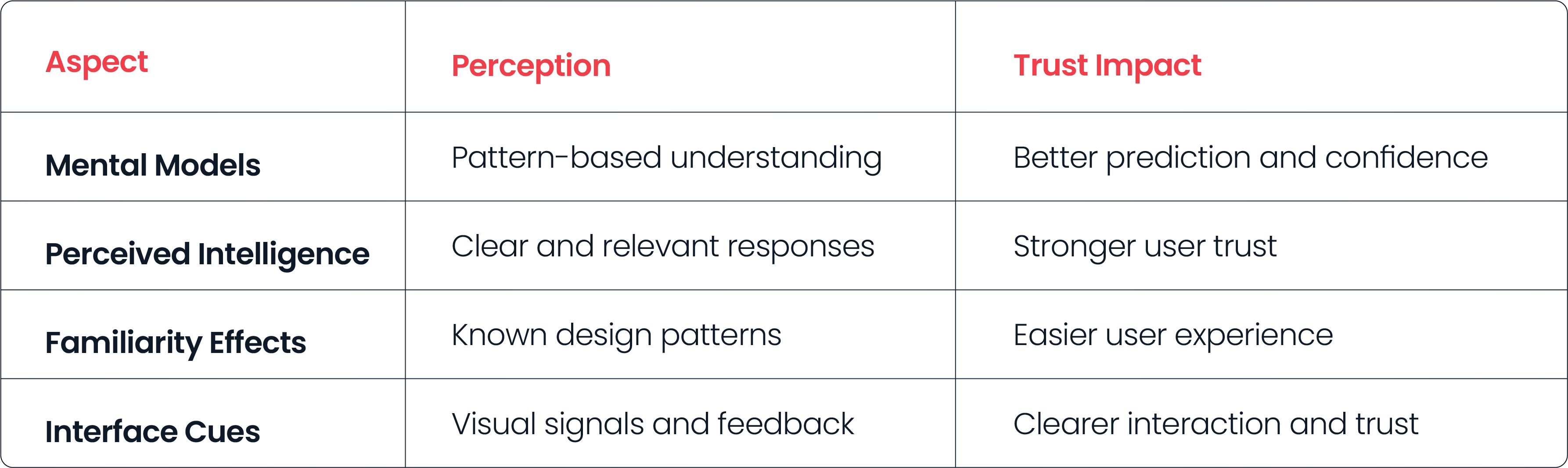
Users rely on what they see and experience during interaction. Psychology explains how these perceptions are formed, while design shapes how information is presented. When both align, users understand systems better and build stronger trust.
Trust in AI grows through user experience, design principles, and human-AI interaction that focus on clarity, usability, and consistent behavior in systems. Good design turns psychological understanding into practical interaction.
Users trust systems when they understand them. Clear explanations and simple outputs improve user experience. Design presents information in a way that supports understanding. Psychology shows that clarity strengthens trust.
Design should not overwhelm users. Showing basic information first, then allowing deeper exploration, supports a better user experience. Psychology explains that gradual information improves understanding and focus during interaction.
Feedback connects user actions with system responses. Clear feedback improves user experience and supports trust. From a psychological view, feedback reinforces learning and understanding. Design ensures feedback is visible and timely.
Human-centered AI design focuses on how users think and act. When interaction follows natural patterns, users feel comfortable. Psychology supports this approach by explaining user behavior. This alignment builds trust through smooth interaction.


AI, automation & smart solutions are reshaping software. Let’s build future-proof technology for your business today!

Trust in AI will evolve through artificial intelligence, user experience, and human-AI interaction, becoming more adaptive, context-aware, and aligned with user psychology and design.
Systems will adjust based on user behavior. Design will present signals that match user needs. Psychology explains how users respond differently based on context, and design adapts to support trust.
User experience will change based on task and intent. AI UX design will show relevant information at the right moment. Psychology supports this by explaining how context affects understanding and trust.
Interaction will become more collaborative. Users and systems will work together. Design will support shared decision-making, while psychology explains how collaboration builds trust.
Systems will adapt to user preferences. Personalized and trustworthy AI design will make interaction more relevant. User trust psychology shows that personalization improves comfort and strengthens trust over time.
As artificial intelligence becomes part of daily life, trust, psychology, and design will shape how users interact with systems. When design gets this right, users feel comfortable, confident, and willing to rely on trust in AI.

Trust relates to user confidence, while reliance depends on how consistently systems support real tasks during interaction.
Clear explanations help users understand outputs, which supports better decision-making and improves overall user trust.
Yes, simple design and clear AI user experience allow users to feel confident without needing a deep understanding of artificial intelligence.
User psychology, expectations, and past experience shape how each person perceives and interacts with systems.
Personalized responses make interaction more relevant, which improves user experience and strengthens long-term trust.


