
Table of Contents
Thank you! Your submission has been received!
Oops! Something went wrong while submitting the form.

Published:
Choosing between a fractional CTO vs staff augmentation comes down to how you handle tech leadership and delivery. A fractional CTO guides product strategy, system architecture, and long-term planning, while staff augmentation adds developers to execute work.
This comparison shows where each model fits, how costs differ, and how they support scaling engineering teams with better control. This article will help you understand which model fits your business goals or if you need both.
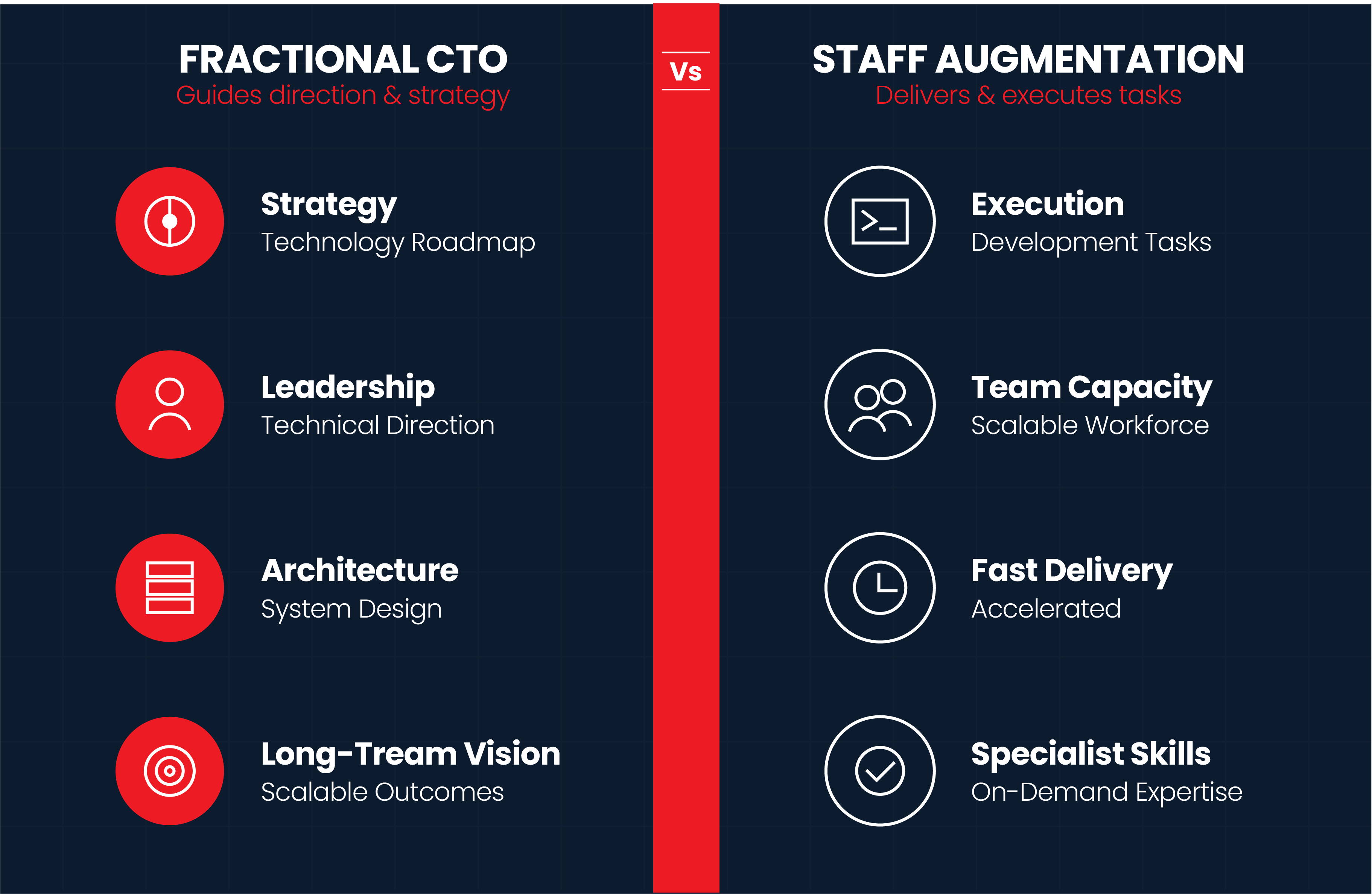
A fractional CTO is an experienced technology leader who takes ownership of your product strategy, system architecture, and key technical decisions while working with your business on a flexible engagement.
They play a critical role in shaping the technology roadmap, guiding development teams, and ensuring the software development lifecycle stays aligned with business goals. A strong CTO brings clarity to complex decisions, improves code quality standards, and keeps technical debt under control.
Instead of just managing tasks, a fractional CTO drives long-term direction, supports digital transformation, and builds a solid foundation for scaling engineering teams with the right processes, tools, and cloud infrastructure in place.
Staff augmentation is a hiring model where businesses extend their existing team by adding external developers to support ongoing software development work. It allows companies to bring in specific skills without long-term hiring.
These developers work as part of your team, follow your workflows, and contribute to the software development lifecycle. This helps maintain code quality standards while speeding up delivery and handling technical tasks more efficiently.
Staff augmentation supports resource allocation during high workload periods and helps teams manage product development, cloud infrastructure, and system updates.
Hire a fractional CTO when you need clear technical direction and someone to guide important product and engineering decisions.
In the early stages, things move fast, but direction is often unclear. A fractional CTO helps define product strategy, plan the technology roadmap, and guide MVP development so you build on the right foundation.
If product decisions feel scattered, a fractional CTO brings clarity. They connect business goals with system architecture and make sure the software development lifecycle stays focused and efficient.
With strong technical leadership, teams move faster with clear direction and better outcomes. A fractional CTO steps in with technical leadership, improves code quality standards, and manages technical debt while setting better workflows.
As you grow, systems and teams get harder to manage. A fractional CTO helps structure cloud computing infrastructure, improve resource allocation, and support scaling engineering teams in a controlled way.

Let’s discuss how we can help you craft a winning product strategy tailored to your goals.

Choose staff augmentation when you need extra development capacity, specific skills, and faster execution within your existing team and workflows.
When your team is overloaded, getting staff augmentation service helps distribute the workload without changing your core team structure.
For limited scope work, this model gives you flexibility without long-term commitments.
When you need expertise in a particular area, staff augmentation fills that gap efficiently.
If speed becomes critical, this approach helps move projects forward faster.
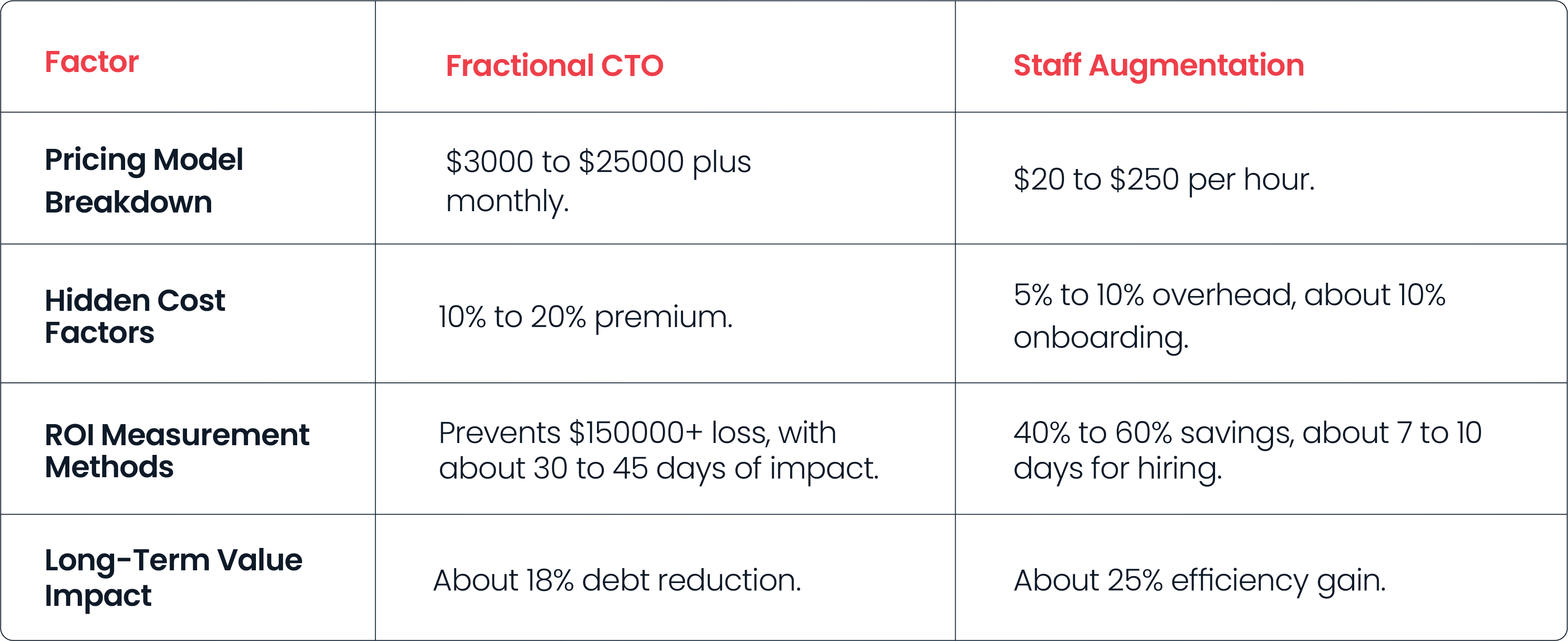
Costs and ROI depend on the balance between leadership value and execution speed, which shapes efficiency, scalability, and long-term technical outcomes.
The following table compares fractional CTO vs staff augmentation models across key cost and ROI factors.
Choose based on your business stage, technical needs, budget goals, and how you balance leadership with execution.
Your stage defines what you need most. Early teams often need strong technical leadership to shape product strategy and build a clear technology roadmap. As the business grows, execution support becomes more important to keep delivery consistent.
If your product involves complex system architecture or cloud infrastructure, leadership becomes critical. A fractional CTO guides decisions, manages technical debt, and keeps the software development lifecycle structured, while developers focus on execution.
Budget decisions should focus on outcomes, not just cost. Leadership helps avoid expensive mistakes and improves long-term planning. Execution support improves resource allocation and speeds up delivery when direction is already clear.
A hybrid model combines technical leadership with external developers, aligning product strategy, system architecture, and execution within one coordinated structure.
This model connects leadership with delivery. It often evolves when teams compare staff augmentation vs outsourcing and choose a more controlled setup. The fractional CTO defines the technology roadmap, while developers support the software development lifecycle through execution.
The fractional CTO leads product strategy, system architecture, and key decisions. This is where fractional CTO services play a central role, guiding teams while augmented staff focus on development tasks and code quality standards.
Teams are built with clear leadership and execution layers. The CTO manages cloud infrastructure, resource allocation, and workflows, while developers integrate into Agile development and DevOps practices for consistent delivery.
This setup supports scaling engineering teams with clarity and speed. It keeps technical debt under control and ensures digital transformation stays aligned with long-term business goals.
Choosing between a fractional CTO and staff augmentation really comes down to what your business needs right now. Do you need direction or more hands-on execution? The benefits of staff augmentation help you move faster, while strong leadership keeps things on track. When both align, scaling engineering teams becomes much more manageable and predictable.

MSP manages outcomes and full IT functions, while staff augmentation adds developers to your team for execution. It gives more control over workflows and delivery.
A fractional CTO provides part-time technical leadership, while a full-time CTO is fully dedicated to one company. The choice depends on a fractional CTO vs. a full-time CTO based on budget and growth stage.
CTOs vary by focus, such as strategy, infrastructure, product, and operations. These roles are often shaped by tech leadership for startups and evolving business needs
Avoid poor communication, unclear ownership, and a lack of technical leadership after onboarding external developers. Strong guidance supports smoother scaling of engineering teams and better long-term results.
Team augmentation adds a full external team, while staff augmentation adds individual developers to your existing team. This often connects to when to hire a fractional CTO for better direction.


