
Table of Contents
Thank you! Your submission has been received!
Oops! Something went wrong while submitting the form.


Published:
Speed is everything in today’s product race. The teams that ship faster win users, capture revenue earlier, and stay ahead while others are still preparing their next release. Slow delivery is not just an operational issue; it is a direct growth killer. This is exactly where DevOps proves its value.
Research from Google Cloud and DORA shows that DevOps reduces product time-to-market by enabling teams to release updates more frequently and shorten delivery timelines significantly, with improvements that can reach up to 40 percent.
Now let’s break down exactly how that speed is achieved in real-world workflows.
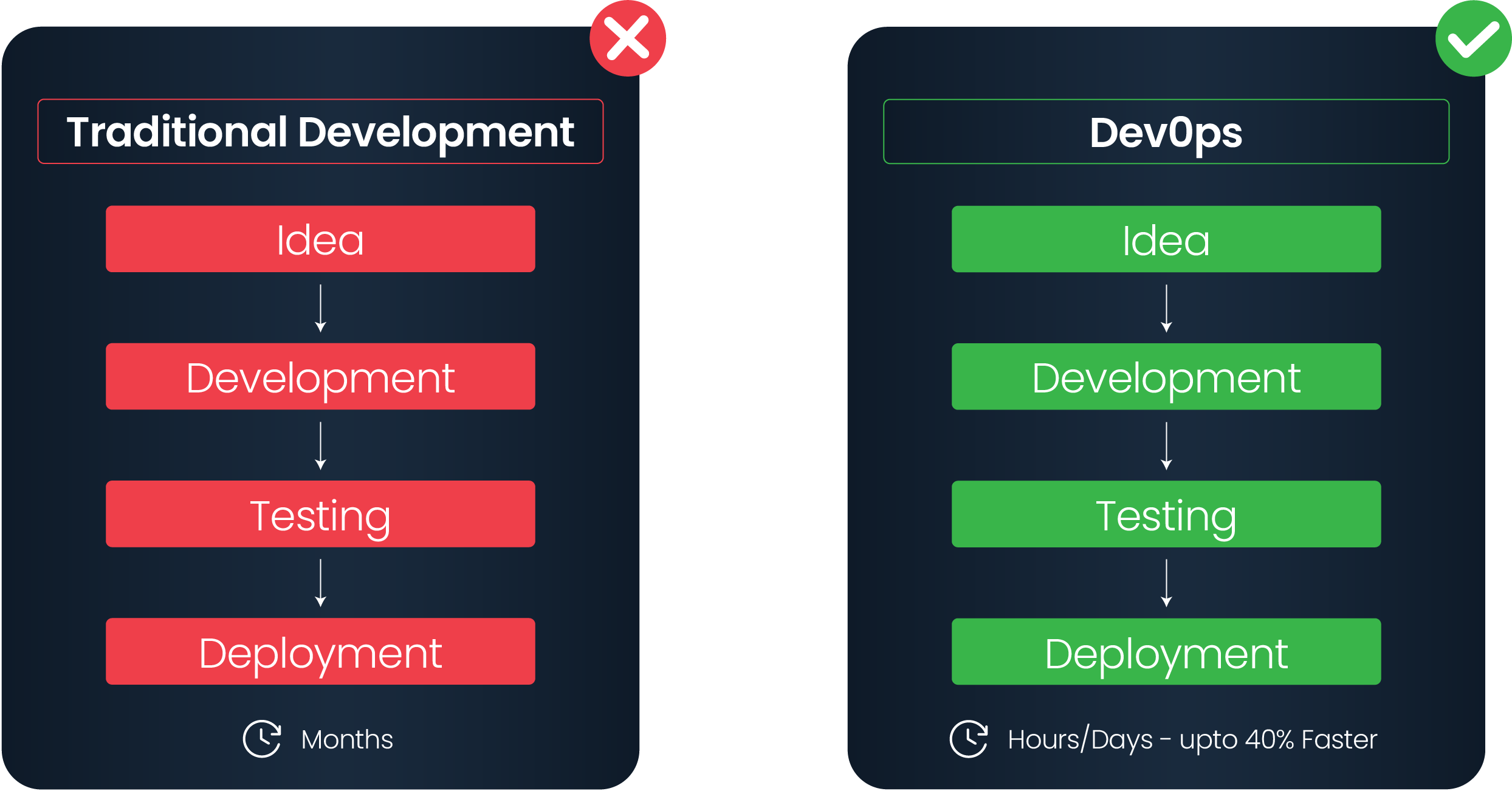
DevOps brings development and operations together to deliver software faster and more reliably. It relies on “continuous integration” to merge and test code frequently, “continuous delivery” to keep releases ready, and automation to handle testing and deployment, reducing delays and improving consistency.
Time-to-market is the total time it takes for a product to move from idea to development, then through testing, and finally into deployment. In practice, most delays do not happen within these stages but between them.
Handoffs between teams slow progress, testing becomes a bottleneck when it is delayed, and environment setup often holds releases back when systems are not ready or consistent.
According to the DevOps Global Report 2026, reducing delivery time is the leading factor driving the industry's $18 billion growth this year.

Most delays in product delivery are not caused by coding itself but by inefficiencies around it, which directly impact how DevOps reduces product time-to-market. Traditional development models introduce friction at multiple stages, extending delivery timelines.
Technology consultation services help businesses identify these traditional bottlenecks to build a strategic roadmap for faster delivery.
DevOps reduces product time-to-market by compressing the entire delivery pipeline, not by improving a single step. The overall 40 percent gain comes from removing delays across integration, testing, deployment, and environment setup at the same time.
Continuous integration and delivery reduce lead time by eliminating large release cycles. According to DORA, elite teams move from commit to production in less than one day, compared to weeks or months in traditional workflows. This shift removes one of the biggest sources of delay in software delivery.
The 2025 DORA report shows that elite teams using automated pipelines now achieve deployment speeds up to 200x faster than low performers.
A large portion of the delivery time is lost in manual testing, approvals, and repetitive tasks. Automation reduces this overhead significantly by removing waiting time between stages and ensuring consistent execution. In mature environments, this cuts a major share of operational delay that typically slows releases.
Continuous integration allows teams to detect issues immediately instead of late in the cycle. Faster detection and resolution reduce rework, which is one of the most time-consuming parts of development. This directly shortens the overall delivery cycle.
When development and operations work in separate silos, handoffs and approvals slow everything down. DevOps removes this gap by aligning teams around shared ownership. Faster communication and decision-making reduce delays that commonly occur between stages.
Environment setup is a hidden bottleneck in traditional workflows. Infrastructure as Code removes this by enabling instant and consistent environment provisioning. What previously took days can be reduced to minutes in mature DevOps systems.

Let’s discuss how we can help you craft a winning product strategy tailored to your goals.

This is where the real shift happens. Teams that once waited months to release updates start shipping in days, sometimes even hours. Releases stop feeling like high-risk events and become part of a smooth, continuous flow. Instead of slowing down to avoid failure, teams move faster with more confidence.
This happens because testing, deployment, and feedback are no longer separate steps but part of one connected system.
The following table clearly shows the difference between with and without DevOps:
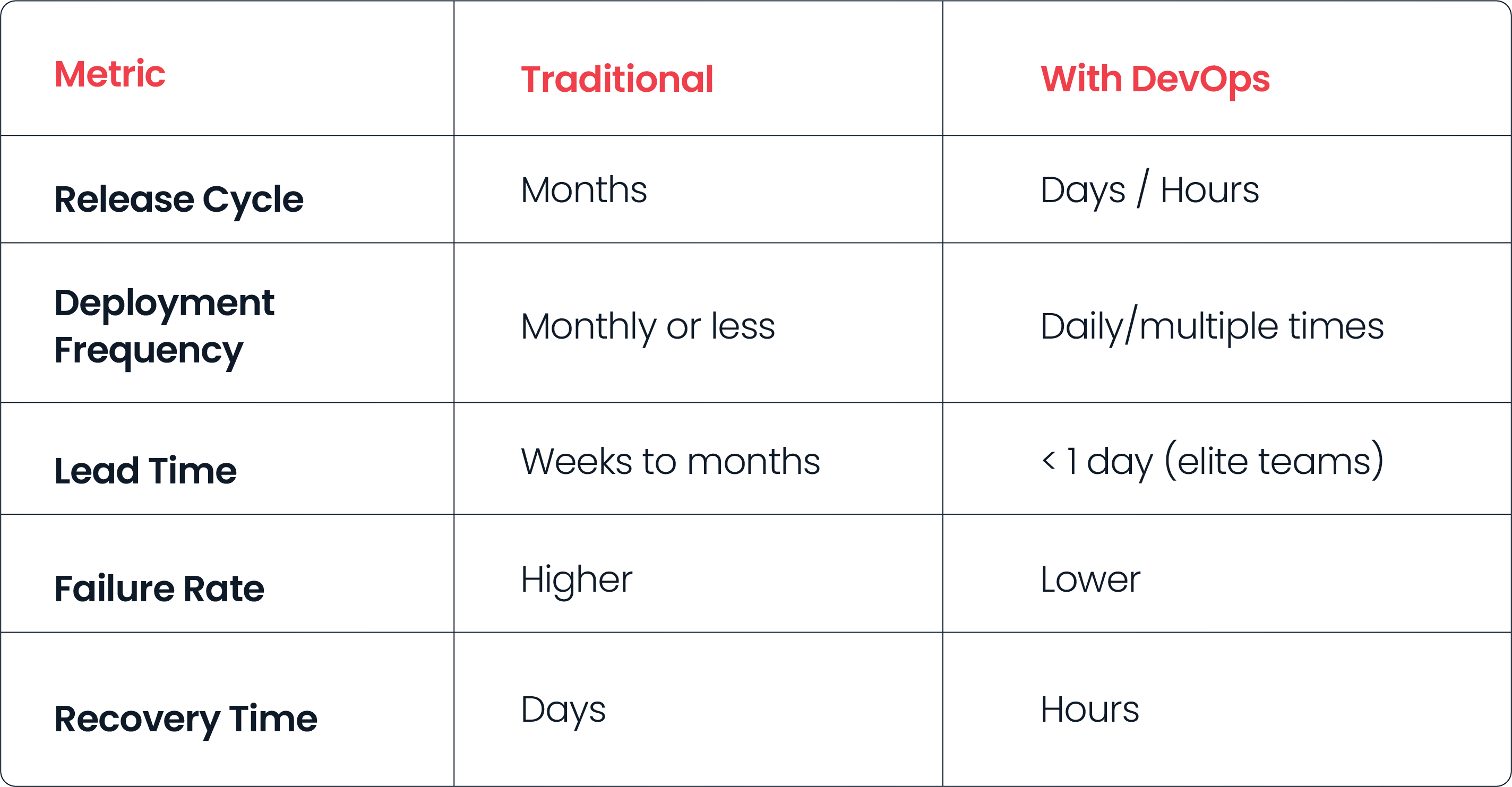
DevOps reduces product time-to-market by transforming how software moves from idea to production. Instead of waiting between stages, everything flows continuously. Code is built, tested, and released without unnecessary delays. This is how DevOps reduces product time-to-market by up to 40 percent, not through one change but by removing friction across the entire system and turning delivery into a fast, reliable process.

Yes. While the cloud accelerates DevOps, core gains come from CI/CD, automation, and workflow efficiency, which can be implemented on-premise as well.
Real-time monitoring reduces detection and response time, preventing small issues from turning into major delays during release cycles.
Yes. Smaller teams often move faster initially, but larger teams gain more long-term benefits once processes are standardized.
Higher release frequency reduces risk by limiting the size of changes, making issues easier to detect and fix quickly.