
Table of Contents
Thank you! Your submission has been received!
Oops! Something went wrong while submitting the form.

Published:
Every few months, you’ll hear a team say, “Serverless saved us time,” while another claims, “Kubernetes gave us control.” Both are right, and that’s exactly the problem. In 2026, apps are more demanding, with unpredictable traffic and heavier workloads.
This guide will give you a better understanding of Serverless vs Kubernetes so you can choose the right one for you.
Serverless runs your code only when needed, without managing servers. Kubernetes manages containerized apps, giving you full control over how they run and scale.
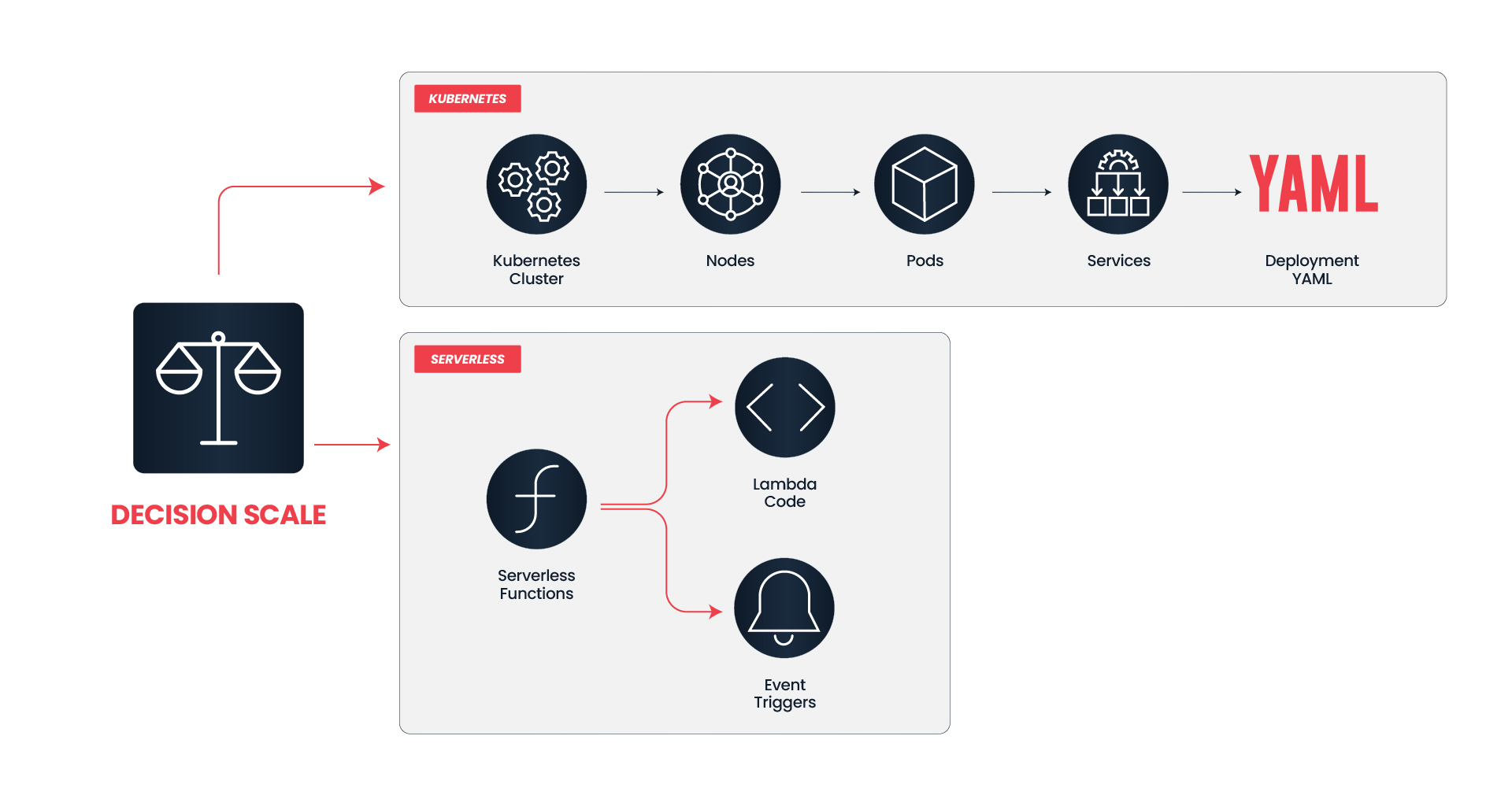
At a glance, both can run modern apps, but the real difference shows under pressure.
Key difference: Serverless can handle sudden spikes instantly, while Kubernetes scaling may take seconds to minutes, depending on configuration.
Serverless can be cheaper at low usage, but at high, steady traffic, Kubernetes often becomes more cost-efficient and predictable.

AI, automation & smart solutions are reshaping software. Let’s build future-proof technology for your business today!

There are a lot of differences when comparing the cost of Serverless vs Kubernetes. You can see the clear difference in the given table:
According to the Cloud Native Computing Foundation, 82% of container users now run Kubernetes in production, showing it has become a standard for modern infrastructure.
1. MVPs and startups: You can launch faster because there’s no need to set up or maintain servers. This is critical when testing ideas or getting to market quickly.
2. Event-driven apps: Serverless works best when actions happen only in response to events, like API requests, file uploads, or scheduled jobs. It runs only when triggered, not all the time.
3. Spiky or unpredictable traffic: If your app gets sudden bursts of users, serverless can scale quickly without pre-planning capacity. For example, platforms like AWS Lambda can increase capacity in steps of 1,000 concurrent executions within seconds, handling rapid traffic growth.
4. Teams with limited DevOps: Since infrastructure is managed by the provider, small teams can focus on building features instead of maintaining systems.
A key advantage often missed: serverless can scale down to zero when not in use, meaning you’re not paying for idle resources, something traditional setups don’t do by default.
For example, a system that sends emails only when users sign up runs efficiently on serverless, because it activates only when needed and doesn’t stay running all the time.
Kubernetes starts to make sense the moment your app stops behaving like a “sometimes” system and becomes an “always-on” one.
1. Microservices at scale: When your app is split into many services talking to each other, Kubernetes keeps everything organized and running without constant breakage.
2. AI/ML or long-running workloads: If your tasks take minutes or hours, Kubernetes handles them reliably, with no hard execution limits cutting things off midway.
3. Multi-cloud or vendor independence: You’re not locked into one provider. Kubernetes runs the same way across clouds, which gives you the flexibility that most teams only realize they need later.
4. Need for deep control: You decide how resources are used, how apps scale, and how traffic flows. Nothing is abstracted away.
Here’s the part many miss: Kubernetes is built for systems that cannot afford to pause, restart, or behave unpredictably.
For example, a video streaming service that runs all day needs Kubernetes to keep performance steady and stay fully in control of resources.


We can teach product teams and agile teams in continuous product discovery with the aid of the product discovery framework, which gives the product discovery process structure.
Most teams don’t fail because they pick the wrong tool; they fail because they don’t match the tool to their situation.
Start with these four questions:
If usage comes in bursts or is hard to predict, Serverless handles it better. If traffic is steady and constant, Kubernetes is usually more efficient.
If you need to fine-tune performance, networking, or scaling, Kubernetes fits. If you just want to run code without managing systems, Serverless is simpler.
Short, event-based tasks work well with Serverless. Long-running processes are better suited for Kubernetes.
Smaller teams benefit from Serverless. Teams with infrastructure experience can take advantage of Kubernetes.
The real shift isn’t choosing one; it’s using both where they fit best. Many teams combine Kubernetes with serverless tools, often using AWS services to manage both scalable infrastructure and event-driven workloads.
In a hybrid setup, you don’t force everything into a single model:
This approach avoids a common mistake: overusing serverless for long-running systems or overcomplicating simple tasks with Kubernetes.
A key advantage often missed: you reduce cost and complexity at the same time. Steady workloads stay stable on Kubernetes, while unpredictable tasks don’t waste resources.
The real question isn’t which is better; it’s what your system actually needs right now. In the serverless vs Kubernetes decision, serverless gives you speed and simplicity, while Kubernetes gives you control and stability. Most teams don’t pick one forever; they start simple, then evolve as their system grows.

Serverless is usually cheaper for low or unpredictable usage because you only pay when code runs. Kubernetes can be more cost-efficient for steady, high-traffic applications running continuously.
Yes, for most small apps, Kubernetes adds unnecessary complexity. Serverless is often a better starting point since it requires less setup and no infrastructure management.
Yes, many teams start with serverless and move to Kubernetes as their system grows. This shift usually happens when they need more control, stability, or long-running workloads.


