Table of Contents
Thank you! Your submission has been received!
Oops! Something went wrong while submitting the form.

Published:
The "all-in-one" days are over. Tech-heavy behemoths like WordPress and Drupal are starting to show their age. With WordPress and Drupal, businesses are left having to settle for things like pre-made templates and plugins. Milliseconds cost businesses money, so time is important.
Flexibility and speed are now the golden standard due to the rapid adoption of Next.js and Headless CMS. Modern digital experiences aren't just about having a website. Today's businesses need high-performance digital experiences, and their infrastructure must be capable of scaling infinitely to serve content on demand.
Next.js is a reactive framework that allows the use of hybrid rendering, which encompasses server-side rendering, static-site generation, and incremental static regeneration, resulting in an unparalleled digital experience.
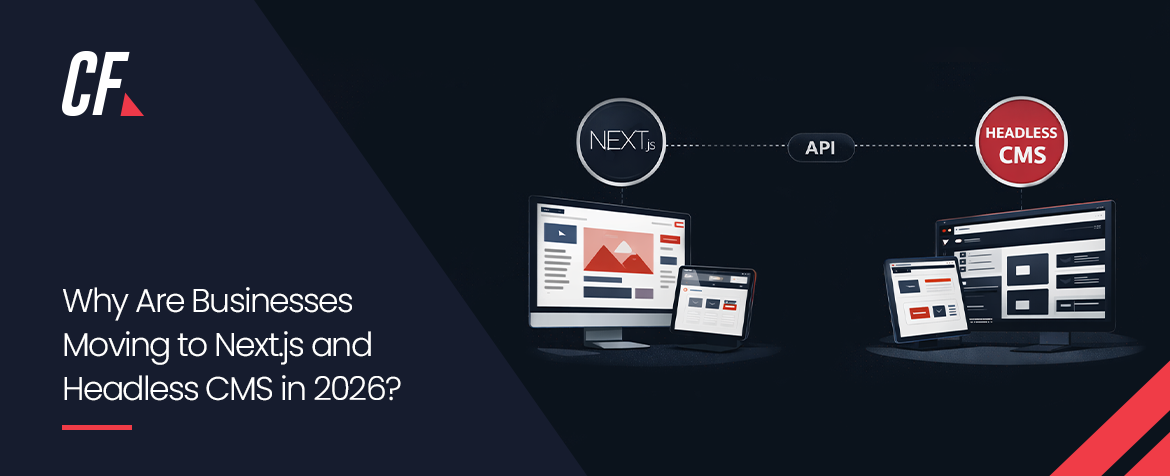
Next.js is a strong structure, but instead of a monolithic system, it offers integration with a Headless CMS, which is a content repository that serves content via an API to the Frontend.
Designers may provide a complete refresh of the Frontend without having to modify the content. Editors can push changes to all channels simultaneously without the risk of crashing the site.
.png)
Next.js is not going away any time soon. It is currently being used to create some of the best-performing websites. According to W3Techs, Next.js usage significantly correlates with high-traffic sites. It is used by 20.8% of the top 1,000 most-visited websites globally.
Next.js breaks the trade-off of making a website fast while keeping the data fresh. Incremental Static Regeneration, or ISR, allows your site to update specific pages that are live, without the need for a full site rebuild. To help search engine crawlers, fully rendered HTML is served, and sub-second load times of a static site are maintained.
Google has a set of requirements called Core Web Vitals that a site needs to hit in order not to be penalized. Next.js was built to improve the Core Web Vitals test. Next.js has various features that will help minimize your site’s LCP and CLS, such as built-in image optimization and font optimization, as well as great defaults for edge rendering to help minimize your site’s TTFB.
With Turbopack being the experimental bundler, new hot reloads can be much faster than the old-school setups. When used with React Server Components, developers can send 50% less JavaScript to the browser. This allows teams to spend more time implementing functionality instead of creating complicated build processes.
Next.js applications can handle enterprise-level traffic. Its seamless integration with global CDNs and edge deployments ensures that massive traffic spikes in specific regions won’t compromise performance globally. This modular architecture is ideal for microservices and high-concurrency setups, making it the best choice for customers who can’t have any downtime.

AI, automation & smart solutions are reshaping software. Let’s build future-proof technology for your business today!

Traditional CMS have to rely on older, less efficient processes, creating bottlenecks with consumer friction. According to the US Census Bureau, with e-commerce now accounting for 18.3% of all US retail sales, businesses can no longer rely on the slow, synchronous processing of monolithic systems. Instead, they are adopting Headless CMS to gain a structural edge in a digital-first economy.
Headless CMS acts as the central content engine. Instead of legacy systems that cause the manual duplication of content for different devices, with this architecture, you can publish a single data object and stream it through APIs to web apps, mobile apps, digital signage, and IoT devices.
With headless architecture, you can also do Static Site Generation (SSG) and deliver content through global CDNs, meaning reduced latency, and digital consumers get content to load instantly.
Editors can go beyond inflexible templates and instead create structured content with reusable content blocks. Such modularity means that teams can create dynamic landing pages or make changes to a global catalog all within a few minutes.
Reducing the attack surface can be achieved by separating the back and front ends. With the repository located behind the API, it also removes legacy platform plugin and theme vulnerabilities.
With the synergy of these two technologies, you get the best of both worlds. Headless CMS is the structured brain behind the scenes, while Next.js handles all the sights and touches of the user.
The Power of Synergy
.png)
Bridging Next.js with a Headless backend requires specialized engineering. It is important to build and scale these systems through professional web app development tailored for high-traffic enterprises.


We can teach product teams and agile teams in continuous product discovery with the aid of the product discovery framework, which gives the product discovery process structure.
Moving to a Next.js and Headless CMS architecture is no longer a luxury; it is a survival tactic for the 2026 digital economy. By decoupling your content from your code, you future-proof your brand against shifting trends. The result is a lightning-fast, secure, and infinitely scalable ecosystem that dominates search rankings.

Your website will be able to withstand the load due to the global CDN. The frontend will keep the database free of requests and will support thousands of concurrent users.
Yes. WordPress can still be used as your “headless” back end. This allows you to keep your existing editor as you transition to a new headless system.
Quite the opposite. Next.js allows you to keep your old headless system, enabling you to keep the same URL structure from your previous system while still receiving a huge boost in performance.