Table of Contents
Thank you! Your submission has been received!
Oops! Something went wrong while submitting the form.

Published:
Every business wants better software development cost planning, yet pricing can change fast from one project to another. A basic internal tool has very different needs from a scalable platform with cloud infrastructure, custom integrations, and advanced software architecture.
The real value also goes beyond the initial development budget. Smart project estimation, quality development, and long-term software maintenance help businesses improve operational efficiency and support digital transformation.
In this article, you’ll learn what actually drives software pricing and where most development expenses come from.
Software development cost mainly depends on project size, feature scope, platform type, tech stack, and integration requirements.
Project complexity has a direct impact on software development cost. The overall software development services cost increases as businesses require advanced software architecture, cloud infrastructure, custom integrations, and workflow automation.
A basic internal business tool in the USA may cost around $75,000 to $160,000, while large enterprise platforms can exceed $1M.
Complex systems require more frontend development, backend development, software testing, and DevOps support. Scalability requirements also increase infrastructure and maintenance costs.
Every feature increases development time and overall software pricing. Simple features such as user login, dashboards, or reporting tools require less effort than AI-assisted development features, payment systems, or real-time analytics.
More features also increase software testing, API development, and software maintenance requirements. Clear feature prioritization helps businesses control their development budget.
Platform selection changes both development expenses and long-term maintenance costs. Web applications, mobile apps, enterprise SaaS products, and cloud-native platforms all require different development workflows.
Cross-platform frameworks such as Flutter and React Native can reduce software development costs because businesses manage a shared codebase. Native applications usually require separate teams and larger maintenance efforts.
Tech stack choice affects development speed, scalability, hiring costs, and software maintenance. In the USA market, senior backend developers and DevOps engineers commonly charge between $150 and $240 per hour, depending on specialization.
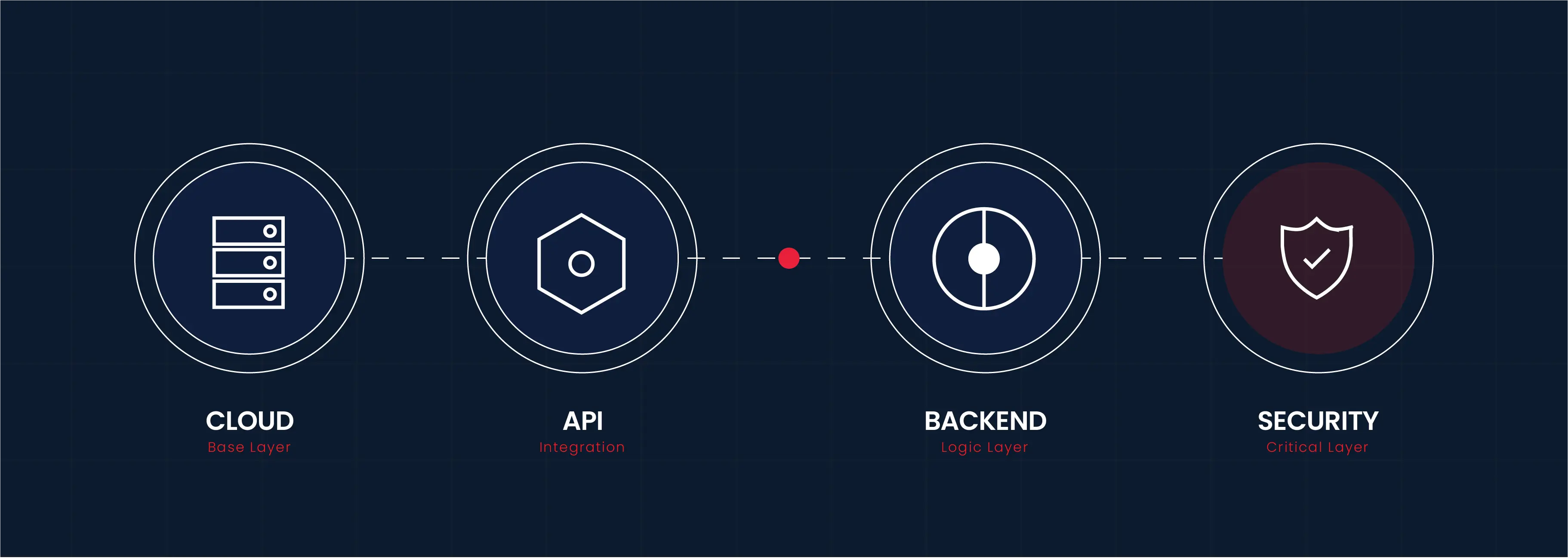
Technologies used for cloud infrastructure, database architecture, API integrations, and cybersecurity also shape the final software development cost.
Third-party integrations increase software development costs because developers must connect external systems securely and accurately.
Payment gateways, CRM software, ERP systems, analytics platforms, and cloud services often require custom API development and additional software testing. Complex integrations also increase long-term maintenance and infrastructure management requirements.
Software development cost changes throughout the software development lifecycle because each stage supports different technical and business requirements.
The discovery phase focuses on project planning, requirement analysis, software architecture discussions, and workflow mapping. Businesses in the USA commonly spend between $5,000 and $25,000 during this stage, depending on project scope and technical complexity.
Strong discovery planning improves project estimation, resource allocation, and long-term development efficiency.
UI UX design costs depend on interface complexity, accessibility planning, and user journey requirements. Medium-sized business platforms in the USA often require between $10,000 and $40,000 for wireframes, interactive prototypes, design systems, and responsive layouts.
Enterprise software with advanced dashboards and customer portals usually requires larger frontend design investments.
Backend development covers server logic, database management, cloud infrastructure setup, API development, and security implementation. This stage usually consumes the largest share of the development budget because it supports system performance, operational efficiency, and scalability.
USA-based senior backend engineers and DevOps specialists commonly charge between $150 and $240 per hour.
The testing process helps improve software stability, security, and performance before launch. Businesses invest in quality assurance, automation testing, performance validation, and cybersecurity checks to support reliable software delivery.
Complex enterprise platforms and AI-powered systems usually require deeper testing workflows and larger QA resources.
Post-launch support includes software maintenance, infrastructure monitoring, performance updates, security patches, and feature improvements.
Continuous maintenance also helps companies support software modernization and future business growth.

Let's help you estimate your software development costs, choose the right approach, and build a scalable solution that supports long-term business growth.

Many businesses focus on initial software pricing while missing ongoing infrastructure, maintenance, and scalability-related development expenses.
Scope creep increases software development costs when businesses add new features or workflows during development. These changes affect timelines, project estimation, software testing, and overall pricing.
Cloud infrastructure creates recurring operational expenses after launch. Businesses pay for hosting, storage, monitoring tools, database management, and API traffic. Medium-sized platforms in the USA often spend between $2,000 and $15,000 monthly on infrastructure and scalability support.
Security compliance increases the cost of custom software because businesses invest in cybersecurity, secure cloud infrastructure, access controls, and compliance audits. Enterprise software and fintech platforms usually require larger security budgets.
Technical debt grows when businesses prioritize fast delivery over software quality and scalability. Poor software architecture and rushed development increase maintenance workloads and long-term operational costs.

Software maintenance includes updates, bug fixes, infrastructure monitoring, and software modernization. Most businesses spend around 15% to 25% of the original software development cost annually on ongoing support.
Hiring models change software pricing through team structure, development speed, communication flow, and long-term resource management costs.
In-house teams provide direct collaboration and stronger project control. USA-based software engineers usually increase operational expenses because businesses also manage recruitment, benefits, office resources, and long-term payroll costs.
Freelance developers work well for smaller projects, quick updates, or short-term development tasks. Costs are usually lower, but project management, communication, and software quality oversight require more internal involvement.
Dedicated development teams give businesses access to full-time specialists without handling internal hiring operations. This model supports stable project workflows, long-term scalability, and continuous software maintenance for growing platforms, such as API-driven software.
Outsourcing agencies provide frontend development, backend development, DevOps support, software testing, and project management under a single service structure. Businesses often choose this model for faster delivery timelines and predictable resource planning.
Offshore development usually offers lower hourly rates, especially in regions such as Eastern Europe and South Asia. Nearshore teams provide closer time zone alignment and smoother communication, which help businesses improve operational efficiency and project coordination.
Software investment affects business growth, operational efficiency, customer experience, scalability, and long-term financial performance across industries.
Well-planned software development helps businesses improve customer experience, automate workflows, and support faster digital services. Enterprise software, SaaS platforms, and workflow automation systems often create stronger revenue opportunities through better operational performance and customer engagement.
Modern software architecture improves operational efficiency by reducing manual processes and improving data management across departments. Automation tools, cloud infrastructure, and DevOps workflows also help businesses manage common challenges in software development more efficiently.
Reliable software performance and better UI UX design help businesses improve customer retention. Fast loading platforms, secure payment systems, responsive interfaces, and stable cloud services support stronger, long-term customer relationships.
Scalable software architecture allows businesses to expand services, users, and digital workflows more efficiently. Cloud native systems, API development, and software modernization strategies also support future operational growth without major infrastructure limitations.
Total ownership cost includes software maintenance, infrastructure management, cybersecurity updates, cloud services, and long-term operational support. Businesses that manage these areas properly often achieve stronger ROI and better financial planning over time.
Software development cost is far more than a project expense. It shapes scalability, customer experience, operational efficiency, and long-term business growth. Businesses that invest in smart software architecture, strong planning, and modern cloud infrastructure build faster, adapt more quickly, and stay competitive in a rapidly growing digital market.

Project timelines depend on software scope, integrations, approvals, and business requirements. Small business platforms may take a few months, while enterprise software systems often require longer development and deployment cycles.
Enterprise software supports larger user bases, complex workflows, advanced cybersecurity, cloud infrastructure, and multiple business integrations. These technical requirements increase development resources and operational planning.
Yes, most modern platforms support continuous feature updates, software modernization, infrastructure upgrades, and scalability improvements after deployment. Ongoing updates help businesses adapt to changing operational needs.
Yes, industries such as healthcare, fintech, logistics, and enterprise SaaS usually require stronger security, compliance systems, and advanced data management, which increase development complexity and operational costs.
Cloud native platforms support better scalability, deployment flexibility, operational efficiency, and infrastructure management. They also help businesses handle growing user activity and changing digital workloads more efficiently.