
Table of Contents
Thank you! Your submission has been received!
Oops! Something went wrong while submitting the form.

Published:
As real-time systems become more common across artificial intelligence and edge AI IoT systems where real-time decisions matter, many teams are stuck choosing between edge AI vs cloud AI. It is not always obvious what fits best.
You have to think about latency, data privacy, cost, and scalability. The rise of hybrid AI makes it even more interesting. In this article, you will learn what actually works for you.
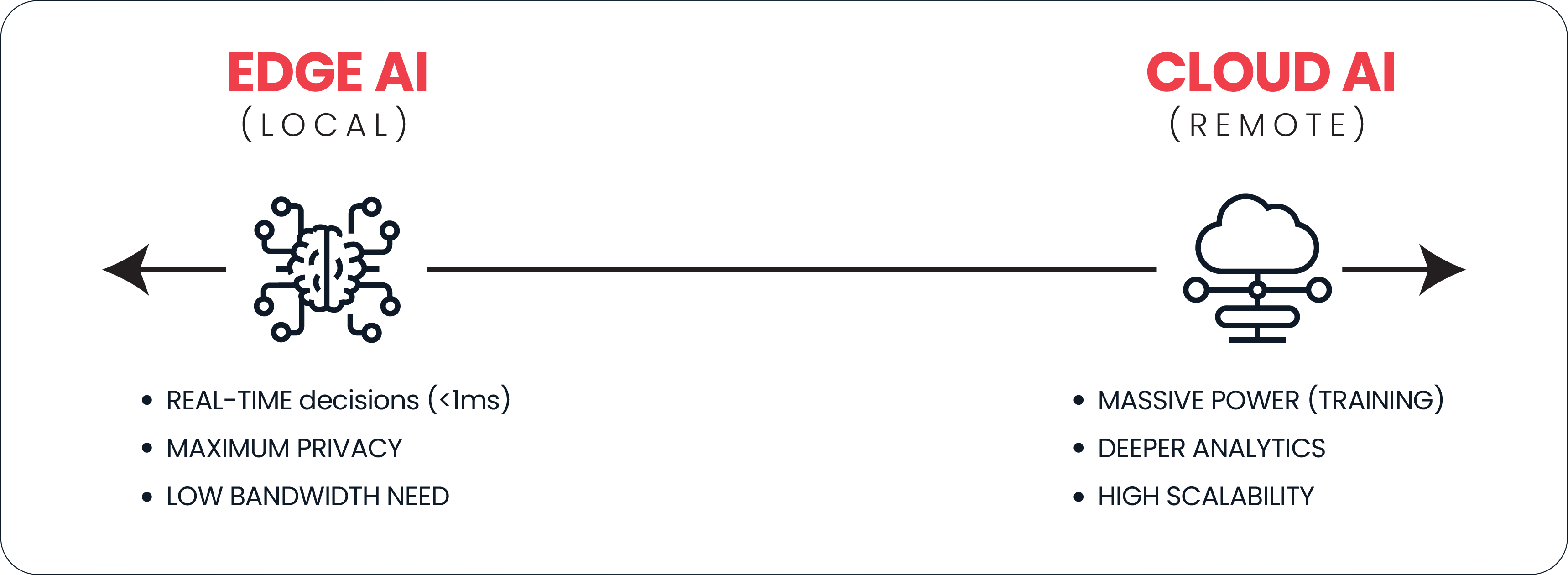
Edge AI means running artificial intelligence directly on local devices instead of sending data to the cloud. It is widely used in Internet of Things systems where fast response matters. This approach is often called edge machine learning, where models run directly on devices.
Processing data close to the source reduces latency and supports better data privacy. You will see it in smart cameras, wearables, and industrial sensors.
Data is processed on the device using trained models. This is called "AI inference." It avoids constant cloud communication and supports real-time decisions. This setup is part of edge AI computing, where trained models process data directly on devices.
Research published in IJRMEET confirms that Edge AI’s local inference is now the primary solution for overcoming the latency gap in 2026 real-time systems.
"Cloud AI" refers to running artificial intelligence models on remote servers instead of local devices. It relies on cloud computing to handle large-scale data and complex tasks.
This approach supports powerful processing, flexible storage, and high scalability. It is commonly used in apps, platforms, and enterprise systems that need continuous learning and updates.
Data is sent to cloud servers where models are trained and used for AI inference. These systems often depend on GPU computing for handling large workloads.

AI, automation & smart solutions are reshaping software. Let’s build future-proof technology for your business today!

Choosing between Edge AI and Cloud AI comes down to where data is processed and how systems handle speed, scale, and control.
This table shows the difference between edge and cloud AI.
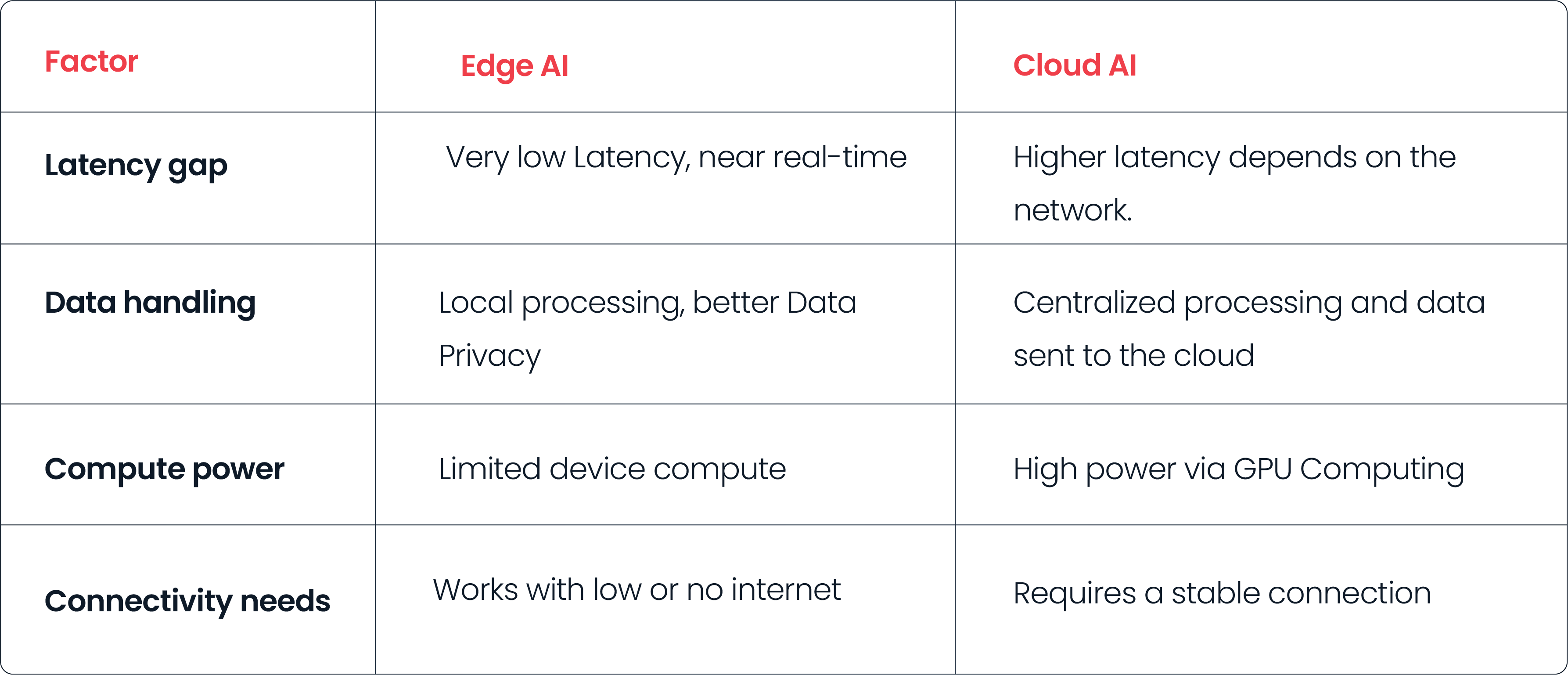
Choosing the right setup depends on how your system handles speed, data, and scale, especially when working with artificial intelligence in cloud computing alongside edge systems.
If your use case depends on fast responses, focus on latency and real-time output. Edge AI works well for instant decisions, while Cloud AI supports deeper processing.
Costs vary based on usage. Cloud setups rely on ongoing compute and storage, while edge systems shift cost toward devices. Total Cost of Ownership helps compare them both over time.
Sensitive data requires strong data privacy and control. Edge systems keep data local, while cloud systems depend on secure transfer and storage.
If your system needs to grow quickly, scalability becomes key. Cloud platforms scale easily, while edge depends on physical device expansion.
Industries usually choose either edge AI or cloud AI based on how fast decisions are needed, how data is handled, and how systems scale in real environments.
Healthcare mainly relies on edge AI for patient monitoring and medical devices. Local processing reduces latency and keeps sensitive data aligned with data privacy needs. Devices like wearables and ICU monitors run AI inference directly on-site for real-time alerts, often integrated through custom mobile app development.
Manufacturing is strongly edge-focused. Machines and sensors process data locally to detect faults and control operations instantly. This setup avoids delays and supports continuous production. Edge systems handle fast decisions without relying on external networks.
Retail mainly uses cloud AI for analytics and business operations. Systems depend on cloud computing to manage large-scale customer data, demand forecasting, and inventory tracking with strong scalability.
Finance is largely cloud-driven due to heavy compute needs. Platforms use GPU computing to run complex models for fraud detection and risk analysis. Centralized systems support large datasets and continuous model updates.
Edge AI vs Cloud AI comes down to what your system really needs day to day. Some setups need instant decisions. Others rely on scale and deep processing. There is no single answer that fits every case. The best choice depends on your use case, data flow, and growth plans, so it is worth thinking it through carefully before you decide.

AI inference runs directly on devices in edge setups, which supports fast decisions. In cloud systems, inference happens on remote servers, which allows handling larger models and more complex outputs.
Bandwidth plays a major role in cloud systems since data must travel back and forth. Edge AI reduces this need by processing data locally, which helps in environments with limited connectivity.
Yes, edge systems can run independently because processing happens on the device. This makes them useful in remote locations where stable internet access is not always available.
AI chips are designed to run models efficiently on devices. They improve speed and energy use, which supports wider adoption of edge AI across different industries.
Distributed systems allow cloud platforms to process large datasets across multiple servers. This setup supports scaling and handles complex workloads more efficiently.


