
Table of Contents
Thank you! Your submission has been received!
Oops! Something went wrong while submitting the form.

.png)
Published:
The minimum viable AI product (MAP) is changing how AI product development works today. Products built on Large Language Models rely on probabilistic outputs, not fixed logic.
Users judge AI user experience through response quality in the first interaction, which directly shapes user retention and product-market fit.
Trust in AI systems, output consistency, and time to value now define what makes an AI product truly viable. This article will give you a clear idea of why AI products need MAP instead of an MVP.

AI product development is shifting because Large Language Models rely on probabilistic outputs, not deterministic systems. This directly affects response quality, output consistency, and how users experience value.
Because of this, “viable” now includes consistency, trust, and AI user experience. This is why the Minimum Viable AI Product is becoming more aligned with modern product-market fit.
A Minimum Viable AI Product (MAP) is the smallest version of an AI system that delivers consistent, reliable, and useful outputs in real-world usage. In modern AI product development, value is judged through actual responses, not just available features.
MAP focuses on how well Large Language Models perform in real use. It includes model quality, stable outputs, fast responses, and a smooth interaction flow.
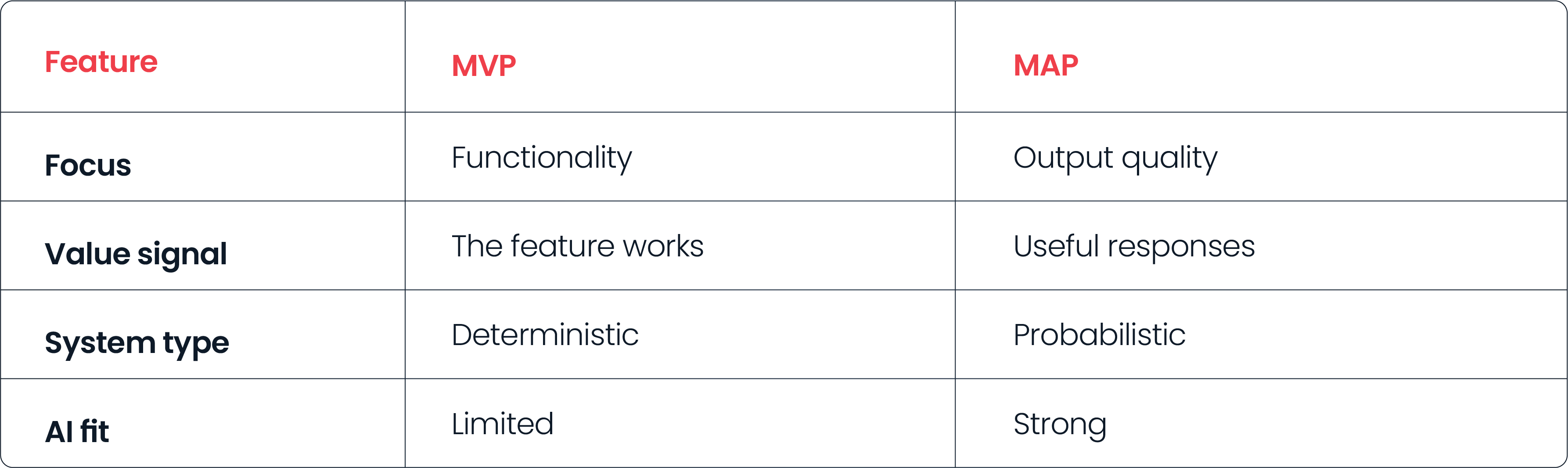
In systems based on probabilistic outputs, viability depends on clear, reliable responses and fast time to value.
AI product development works differently because AI systems rely on probabilistic outputs. This changes how product validation is approached, since value depends on how the system performs in real interactions, not just whether a feature exists.
Large Language Models can produce different responses for the same input. This makes evaluation more focused on response quality, relevance, and consistency. Teams need to observe patterns across interactions rather than rely on fixed test cases.
Hallucinations are a known behavior in AI systems. Because of this, trust in AI systems becomes part of the product itself. Clear, accurate, and grounded responses help build confidence over repeated use.
AI user experience is shaped by how quickly the system responds. Faster interaction improves time to value and keeps users engaged during real-time conversations.
AI products depend on data quality, context, and continuous updates. Techniques like Retrieval Augmented Generation and fine-tuning help improve response quality over time and support better product-market fit.
Minimum Trust Threshold (MTT)
For an AI product to feel viable, it needs to reach a clear trust baseline. Users form their judgment through actual responses, so consistency and accuracy matter from the start. When this threshold is met, users are more likely to continue using the product and explore its value further.

Let’s discuss how we can help you craft a winning product strategy tailored to your goals.

The minimum viable AI product improves retention by focusing on how users experience value in real time. In AI product development, users decide quickly based on response quality, which directly shapes product-market fit.
With Large Language Models, the first response sets expectations. Clear, relevant, and useful outputs show immediate value. This strengthens AI user experience and encourages users to continue exploring the product.
Early interactions shape how users perceive trust in AI systems. Consistent outputs and smooth interaction create a positive experience, which supports ongoing usage and stronger retention.
User feedback in AI products comes from real interactions, not just feature usage. High-quality responses lead to clearer signals, which help teams improve AI reliability and refine the product over time.
AI products often grow through the outputs they generate. Useful responses can be shared, reused, or integrated into workflows, which supports organic distribution and expands reach.
The First Output Moment is when a user sees the first response from the system. This moment shapes perceived value. The minimum viable AI product is designed to make this interaction clear, useful, and reliable, which supports both retention and product-market fit.
According to a16z, AI retention is governed by the "Cinderella Glass Slipper" effect. If the system’s output does not fit the user's specific intent immediately, they will not return.


Learn why MVPs fail, from weak validation to ignoring real user behavior & poor product-market fit. Discover practical fixes to build & validate better MVPs early.
Startups can move from a traditional Minimum Viable Product (MVP) to a minimum viable AI product (MAP) by shifting focus from features to real output quality. In AI product development, this transition happens in layers, where backend systems and user experience evolve together.
This stage focuses on the foundation. Teams work on data quality, pipelines, and model tuning. Large Language Models are tested, improved, and aligned with the use case. The goal is to build strong internal performance before exposing the system to users.
Once the system produces stable and useful outputs, the focus shifts to the user-facing experience. Here, AI user experience, response quality, and time to value become central. This is where the minimum viable AI product takes shape and supports real product-market fit.
MVP remains useful in parts of the product that do not rely on AI outputs. For example, core workflows, dashboards, or supporting features can still follow traditional product validation methods. This keeps development efficient while AI components evolve.
Start with a clear use case and define what good output looks like. Improve AI reliability through testing and iteration. Focus on trust in AI systems, response consistency, and fast interaction. Then bring the experience to users in a way that highlights real value from the first interaction.
The minimum viable AI product (MAP) is not just a framework. It reflects how AI products are actually used today. When response quality, AI reliability, and trust in AI systems define value, MAP gives teams a clearer path to product-market fit in modern AI product development.

AI reliability directly shapes user retention because consistent outputs build trust in AI systems. When response quality stays stable across interactions, users are more likely to continue using the product and integrate it into their workflow.
Launching an AI product starts with a focused use case and strong data foundations. Using Large Language Models, teams should prioritize prompt engineering, Retrieval Augmented Generation, and response quality to deliver real value from the first interaction.
Large Language Models shape AI user experience through response quality, context handling, and interaction flow. Their ability to generate relevant and clear outputs directly affects how users perceive value and usefulness.
The limitations of MVP appear when evaluation is based only on functionality. AI systems require consistent outputs and strong AI reliability, which means product validation must include real interaction and response quality.
Output consistency ensures that users receive reliable and predictable responses. In AI product development, this builds trust in AI systems and supports long-term product-market fit through stable performance.


