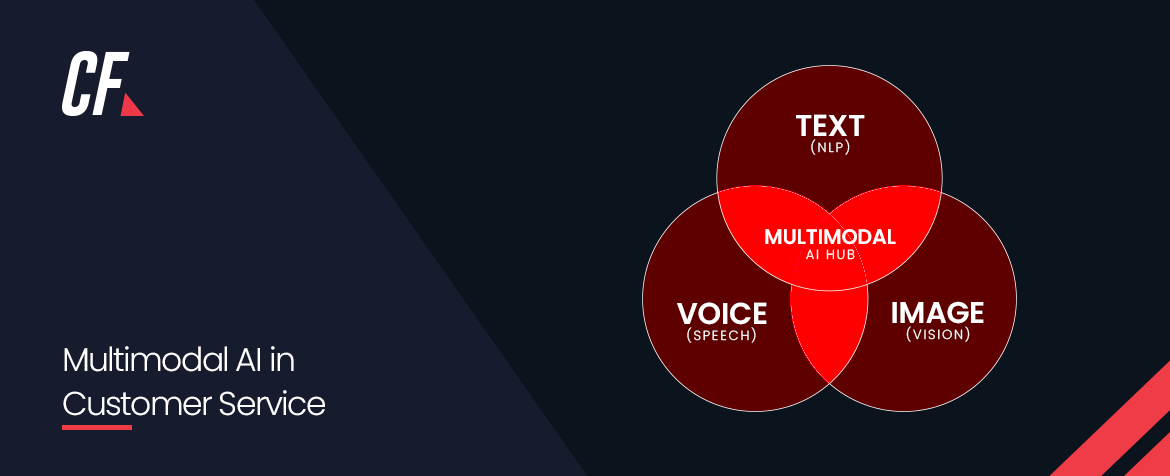
Multimodal AI is quietly changing how support actually feels, especially in customer service, where customers expect quick and clear help. People don’t just type anymore. They send images, speak, and react in the moment.
It brings together natural language processing, computer vision, and speech recognition to understand what customers mean, not just what they say.
In this article, you’ll see how this shift is shaping real customer interactions and what it means for modern support.
What is Multimodal AI in Customer Service?
It helps systems read text, voice, and visuals together, so customer intent becomes clearer and responses feel more relevant instantly.
Multimodal AI in customer service means using natural language processing, computer vision, and speech recognition together to understand customer interactions more completely.
Instead of relying on just text or voice, it brings multiple inputs into a single system, which improves intent recognition and context awareness.
This approach supports multimodal AI use cases like chatbots, voice assistants, and visual support tools. It helps businesses handle real conversations across channels, making customer experience more connected, responsive, and aligned with how people actually communicate today.
How Does Multimodal AI Understand Customer Intent Better?
It looks at words, tone, visuals, and behavior together, so intent becomes clearer and responses match what customers actually need.
Context-aware Responses
Multimodal AI connects signals from text, voice, and visuals to build context. Natural language processing reads the message, speech recognition captures tone, and computer vision adds visual clues. This combined view helps systems respond based on the full situation, not just isolated inputs.
Sentiment Analysis Models
Sentiment analysis works across voice and text to detect emotion and urgency. It helps conversational AI adjust replies based on how the customer feels. In real interactions, this improves clarity and supports more accurate intent recognition during live conversations.
Behavioral Data Signals
Behavioral analytics tracks how customers interact across channels. Click patterns, message timing, and interaction history all add signals. These inputs support a better understanding of customer intent and improve how responses are generated in ongoing conversations.
Cross-modal Learning
Cross-modal learning allows systems to connect insights across different data types. It links text, images, and voice into an understanding process. This is a key part of how to use multimodal AI effectively, since it helps models learn from combined inputs instead of isolated data.
How Does Multimodal AI Enable True Omnichannel Support?
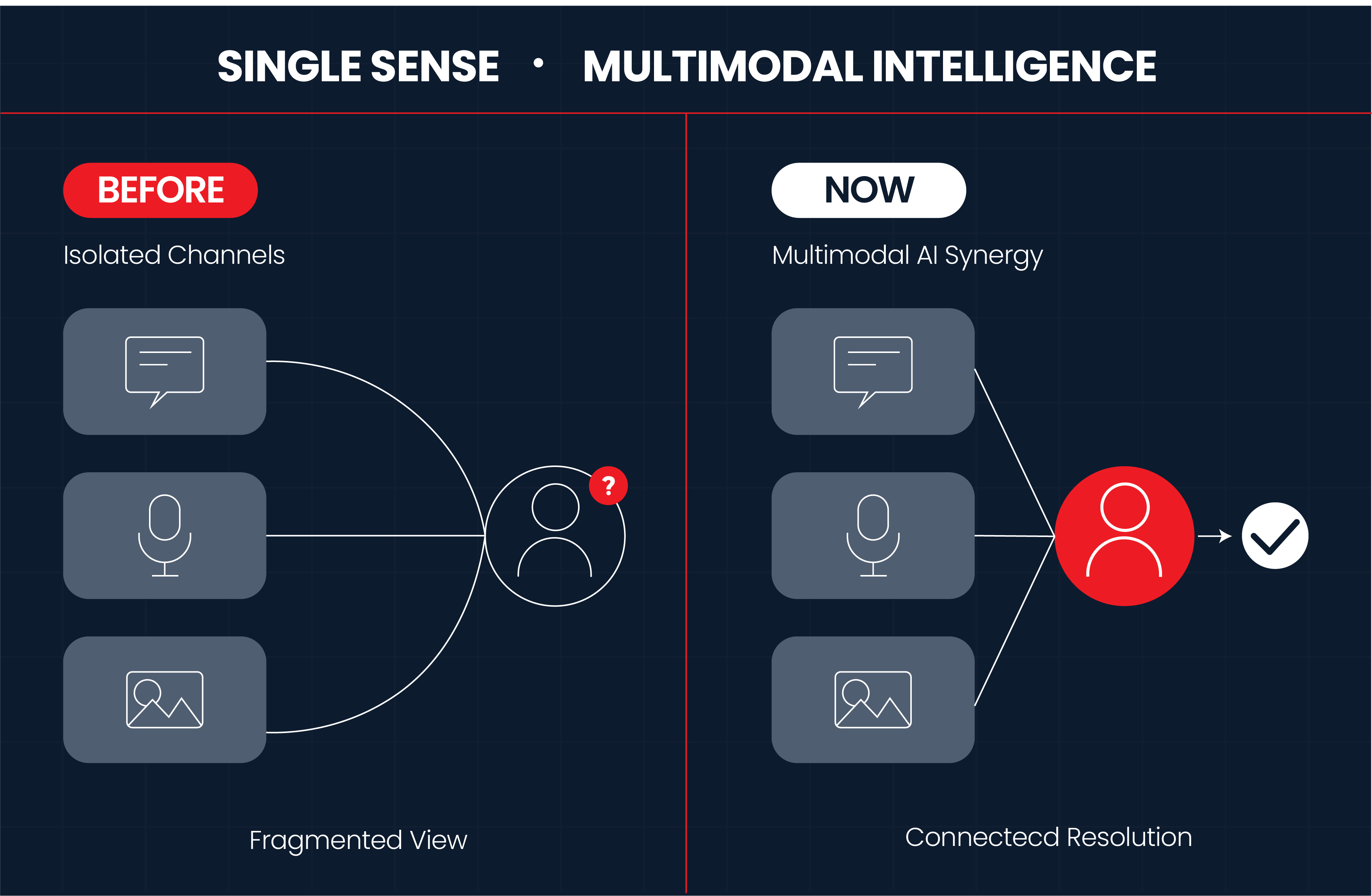
It keeps conversations connected across channels, so customers can switch anytime and still feel like they are in the same interaction.
Omnichannel CX Platforms
Multimodal AI works inside platforms that bring chat, voice, and visual interactions into a single place.
Handles multiple input types in a single system.
Keeps conversation flow continuous.
Supports consistent responses across channels.
Cross-Channel Data Sync
When a customer moves from chat to a call or shares an image, the system keeps the context updated.
Syncs interaction data in real time.
Uses integrations to pass context forward.
Prevents conversation resets.
Unified Customer Profiles
All interactions feed into a single customer view that updates continuously.
Combines history and live activity.
Tracks preferences and behavior.
Helps systems respond with better context.
Real-Time Interactions
Multimodal AI processes inputs as they happen within the same interaction flow.
Updates instantly across channels.
Supports live conversation continuity.
Improves response timing and relevance.
Innovate Faster with Advanced Tech!
AI, automation & smart solutions are reshaping software. Let’s build future-proof technology for your business today!
What Business Problems Does Multimodal AI Actually Solve?
It tackles everyday support issues that affect speed, clarity, and workload, helping businesses handle customer interactions with better accuracy and flow.
High Support Volumes
Customer support teams deal with large volumes of requests across chat, voice, and other channels. Multimodal AI helps manage this by using conversational AI, virtual agents, and automated ticketing systems to handle routine queries. This allows contact centers to process more interactions without overloading systems or teams.
Slow Response Times
Response times depend on how efficiently systems process customer input and context. By combining natural language processing, speech recognition, and computer vision, multimodal AI improves how quickly customer intent is understood. This leads to faster responses and smoother interaction flow within AI-powered customer service environments.
Customer Frustration Issues
Customers prefer clear, relevant responses with minimal repetition across interactions. Multimodal AI uses sentiment analysis and behavioral analytics to understand tone, intent, and context. This helps reduce friction in conversations and supports more accurate responses across different stages of the customer journey.
Agent Workload Reduction
Support teams often spend time on repetitive queries and manual processes. Multimodal AI supports automation through chatbots, voice assistants, and intelligent workflows. This improves agent productivity and allows teams to focus on more complex customer needs while maintaining consistent service quality.
How Does Multimodal AI Impact Customer Experience Metrics?
It directly changes how fast you respond, how well you solve issues, and how customers feel after every interaction.
First Response Time
When a customer reaches out, speed matters. Multimodal AI reduces delays by instantly understanding messages, voice input, and even shared visuals. This allows systems to respond right away, which keeps customers engaged instead of waiting or dropping off.
Customer Satisfaction Scores
Customers care about getting the right answer, not just a fast one. With natural language processing and sentiment analysis, systems understand intent and tone together. This leads to more accurate replies, which improves how customers rate their overall experience.
Resolution Rate Improvements
Fewer interaction steps help improve resolution efficiency and overall experience. Multimodal AI improves the resolution rate by using full context from the start. When systems understand the issue clearly, they can provide complete answers in the same interaction instead of partial responses.
Customer Retention Metrics
People stay with businesses that feel easy to deal with. Multimodal AI keeps interactions consistent across the customer journey, supported by behavioral analytics and real-time context. That consistency builds trust, and trust keeps customers coming back.
How Will Multimodal AI Shape Future Customer Service?
It is moving support from reactive replies to proactive help, where systems understand, predict, and assist customers before they even ask.
According to Kalin Dimtchev (Microsoft), AI agents with enhanced memory and multimodal capabilities will revolutionize processes, enabling people to interact with technology in smarter, more efficient ways.
Generative AI Models
Generative AI models are changing how responses are created. Instead of fixed replies, systems generate answers based on context, intent, and conversation history. Combined with natural language processing, this allows more flexible and relevant communication during real customer interactions.
Predictive Analytics Systems
Predictive analytics uses past behavior and interaction patterns to anticipate what customers might need next. With behavioral analytics and real-time data, systems can identify trends and trigger support actions early. This plays a key role in advanced multimodal AI use cases where timing matters.
AI-Human Collaboration
Future customer service is not just automation. It is coordination. Multimodal AI supports agents by providing context, suggestions, and insights during live interactions. This improves decision-making while keeping human involvement where it adds the most value.
Hyper-Personalization Engines
Hyperpersonalization uses data from multiple touchpoints to tailor each interaction. By combining customer journey data, preferences, and real-time inputs, systems can deliver responses that feel specific to each user. This is where multimodal AI starts to shape long-term customer relationships through more relevant experiences.
Conclusion
Multimodal AI is changing how support feels day to day. Customers get quicker, clearer help, and they don’t have to repeat themselves again and again. For businesses, it means smoother conversations and happier customers. If you get this right, your support won’t just work better, it will actually feel better to use.
Key FAQ’s
Can multimodal AI improve customer trust over time?
Yes, when responses stay consistent across channels, customers feel understood. This directly strengthens multimodal AI customer experience and builds long-term trust with your brand.
Is multimodal AI suitable for small businesses or only enterprises?
It works for both. With cloud-based tools, even small teams can start using multimodal AI without heavy infrastructure or large budgets.
How does multimodal AI handle complex customer issues?
It combines text, voice, and visual inputs to understand the full context, then routes or resolves queries more accurately within the same interaction.
Where does voice and video support fit into multimodal AI?
It plays a key role in voice and video AI customer support, where systems can analyze tone, visuals, and speech together for better understanding.
How can businesses start implementing multimodal AI today?
Start with chatbots or voice assistants, then expand into visual inputs and analytics. A phased approach helps integrate it smoothly into existing systems.
Ali Afzal, Technical Lead at CodeFulcrum, bringing over 7+ years of expertise in software product development, strategic technology leadership, and scaling high-growth engineering teams.