
Table of Contents
Thank you! Your submission has been received!
Oops! Something went wrong while submitting the form.

Published:
If you look at early-stage startups, single patterns keep showing up. Many founders still struggle to understand why MVP fails. Even with Lean Startup and better product development practices, teams often rush into building without proper validation.
They collect user feedback but miss real user behavior. The issue is rarely about software development. It usually comes down to unclear assumptions, weak decision-making, and a lack of focus on actual market demand.
A minimum viable product is the simplest version of a product that helps you test an idea with real users. Instead of building everything, you focus on a single core value and see how people actually use it.
MVP development helps you understand user behavior, gather user feedback, and check real market demand so you can move step by step toward product-market fit through early product development.
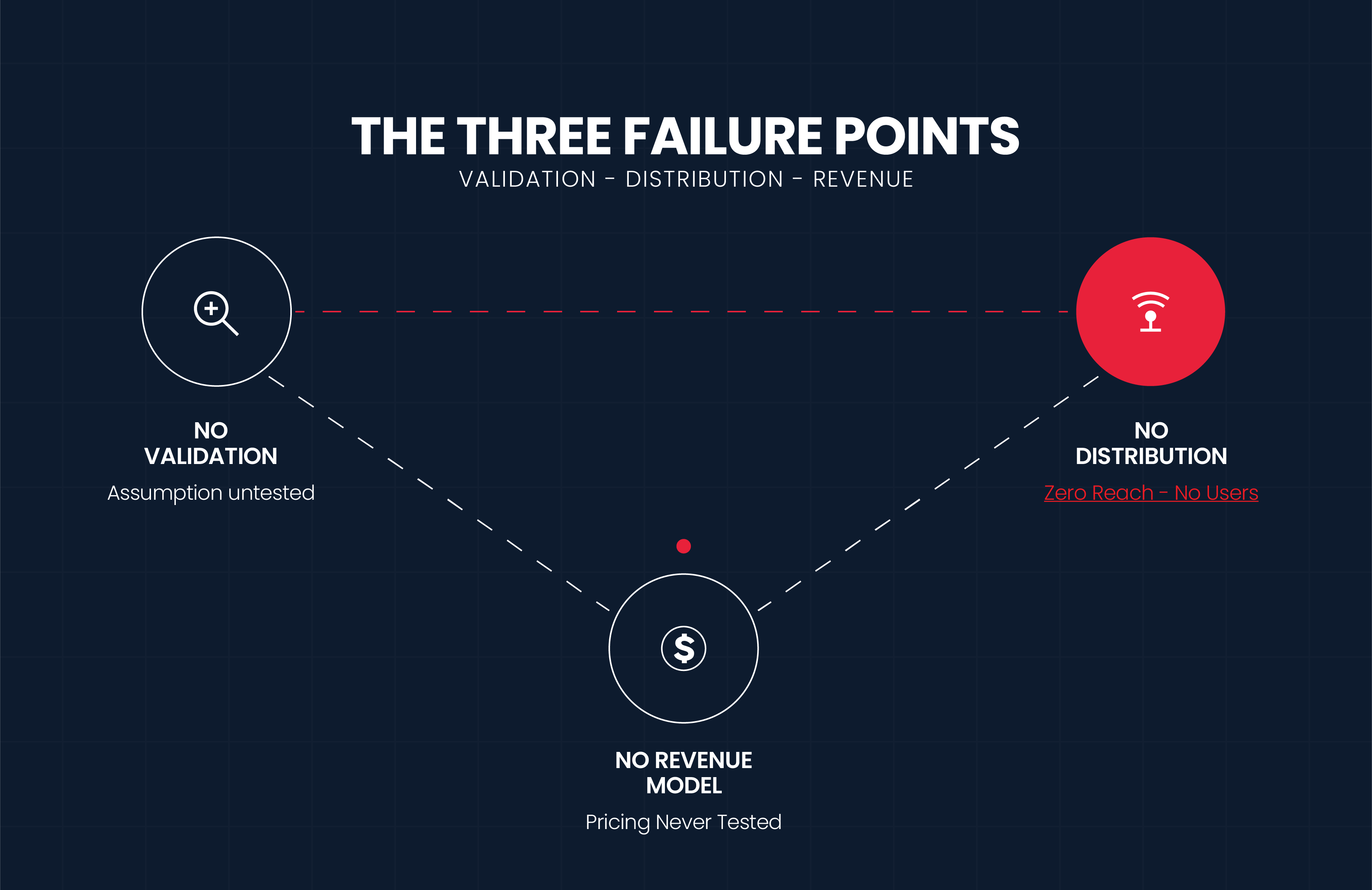
When a minimum viable product is built without testing real market demand, it affects both founders and users. Teams spend time on product development, but the product fails to resonate with early adopters.
Users do not see clear value because their actual needs were not fully understood through proper validation and customer development.
Many teams move forward without confirming the core problem. They rely on ideas rather than direct user input. Without clear market demand, it becomes difficult to achieve product-market fit.
Every product starts with assumptions, but these need to be tested through hypothesis testing. When teams skip this step, decisions are not based on real user behavior or reliable user feedback.
A product works best when it solves a real and specific problem. If users do not feel a strong need, they are less likely to engage, which affects retention rate and overall user experience.

AI, automation & smart solutions are reshaping software. Let’s build future-proof technology for your business today!

An MVP is meant to help teams learn fast, but many founders treat it like a final product. This changes how it is built and how users experience it.
According to Harvard Business Review, an MVP should be viewed as a search for a repeatable business model rather than just the first version of a technical tool.
An MVP should start with a clear purpose. When that is missing, teams build without knowing what they want to learn. This makes user feedback harder to use in a practical way.
When attention goes toward adding features, the main value proposition becomes less clear. More features do not always improve user experience, especially when the core use is still being explored.
An MVP works best when there is a clear learning goal behind it. Without that focus, teams collect data but struggle to turn it into data-driven decisions based on real user behavior.
Distribution decides whether an MVP reaches the right people at the right time. When this step is delayed, both founders and users feel the impact. Teams complete product development but struggle to connect with early adopters.
Without a clear go-to-market strategy and defined acquisition channels, it becomes harder to observe real user behavior or build meaningful feedback loops.
Many teams build first and think about users later. Without an early group of early adopters, there is no steady source of user feedback during the early stage. This slows down progress toward product-market fit.
An MVP is also a chance to test how users find the product. When acquisition channels are not explored early, teams miss important signals about reach and engagement. This affects conversion rate and overall growth direction.
Without initial users, there is no real interaction with the product. This means no reliable user behavior data, which limits the ability to improve the user experience or refine the value proposition.
An MVP helps test if a product creates value, but it should also show how that value turns into a working revenue model. When this part is skipped, founders build something people use but do not connect it with a clear pricing strategy or monetization path.
This is often a single reason why MVP is bad from a business point of view, because usage also does not support long-term product development or real market demand.
Many teams delay testing the price. Without a simple pricing strategy, it is hard to understand how users respond to value. Early pricing signals help shape the value proposition and support better decision-making.
Free access can help attract users, but it does not always reflect real user behavior around paying. Relying only on free users is one of the common patterns seen in many MVP failures, where engagement exists, but business value stays unclear.
When revenue model thinking is delayed, teams focus only on usage. This creates gaps in understanding what causes MVP to get worse over time, especially when growth does not connect with monetization and long-term sustainability.
In early-stage product development, decisions shape how an MVP evolves. When those decisions rely more on personal judgment than real user behavior, both founders and users feel the impact.
Instead of steady progress toward product-market fit, direction becomes unclear. This is a key reason why MVP fails, as choices are not guided by consistent validation or meaningful user feedback.
Founders often trust their initial idea strongly, which can influence how they interpret results. This can limit the role of real user behavior in shaping the product and affect balanced decision-making.
User input is valuable when it is observed and applied carefully. When user feedback is not reviewed in context, it becomes harder to improve the value proposition or refine the overall user experience.
Without tracking simple signals like conversion rate or retention rate, teams miss patterns in how users interact with the product. This reduces the ability to make clear, data-driven decisions during early growth.
An MVP should eventually become a Minimum Lovable Product (MLP). According to Invensis Learning, it’s not enough for a product to just work; it must also be something users actually enjoy using.
Building an MVP is not just about speed. It is about clarity and learning from real users. Why MVP fails often comes down to missed validation, weak decisions, and a lack of focus. When teams stay close to user behavior and market demand, progress becomes much more consistent and meaningful.

Most MVPs struggle when they are built without proper validation of user needs and market demand.
By focusing on real user behavior, collecting feedback, and improving the core value step by step.
No, an MVP works best when it focuses on one clear problem and delivers a simple, usable solution.
An MVP should be built as quickly as possible while still being usable so teams can start learning from real users without unnecessary delays in product development.
Yes, an MVP can succeed with a small group of early users, as long as it provides clear value and generates meaningful user feedback.


